
R211x-HP Flexfabric 11900 IP Multicast Configuration Guide


72
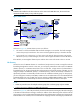
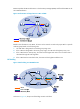
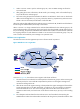
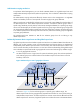
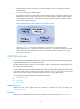
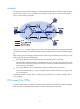
After receiving a multicast data packet, the multicast router checks to which VPN the data packet belongs,
and then forwards the packet according to the multicast routing table for that VPN or creates a multicast
routing entry for that VPN.
Protocols and standards
• RFC 3973, Protocol Independent Multicast-Dense Mode (PIM-DM): Protocol Specification(Revised)
• RFC 4601, Protocol Independent Multicast-Sparse Mode (PIM-SM): Protocol Specification (Revised)
• RFC 5059, Bootstrap Router (BSR) Mechanism for Protocol Independent Multicast (PIM)
• RFC 4607, Source-Specific Multicast for IP
• Draft-ietf-ssm-overview-05, An Overview of Source-Specific Multicast (SSM)
Configuring PIM-DM
This section describes how to configure PIM-DM.
PIM-DM configuration task list
Task at a
g
lance
(Required.) Enabling PIM-DM
(Optional.) Enabling the state refresh feature
(Optional.) Configuring state refresh parameters
(Optional.) Configuring PIM-DM graft retry timer
(Optional.) Configuring common PIM features
Configuration prerequisites
Before you configure PIM-DM, configure a unicast routing protocol so that all devices in the domain are
interoperable at the network layer
Enabling PIM-DM
Enable IP multicast routing before you configure PIM.
With PIM-DM enabled on interfaces, routers can establish PIM neighbor relationship and process PIM
messages from their PIM neighbors. When you deploy a PIM-DM domain, HP recommends that you
enable PIM-DM on all non-border interfaces of the routers.
IMPORTANT:
A
ll the interfaces on a device must operate in the same PIM mode in the public network or the same VPN
instance.
To enable PIM-DM: