
R211x-HP Flexfabric 11900 Layer 3 - IP Routing Configuration Guide


149
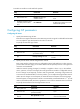
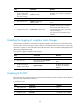
Ste
p
Command
Remarks
4. (Optional.) Suppress
the SA bit during
restart.
graceful-restart suppress-sa
By default, the SA bit is not suppressed.
By enabling the GR restarter to suppress the
Suppress-Advertisement (SA) bit in the hello
PDUs, the neighbors will still advertise their
adjacency with the GR restarter.
5. (Optional.) Configure
the T1 timer.
graceful-restart t1 seconds count
count
By default, the T1 timer is 3 seconds and can
expire 10 times.
6. (Optional.) Configure
the T2 timer.
graceful-restart t2 seconds By default, the T2 timer is 60 seconds.
7. (Optional.) Configure
the T3 timer.
graceful-restart t3 seconds By default, the T2 timer is 300 seconds.
Configuring BFD for IS-IS
BFD provides a single mechanism to quickly detect and monitor the connectivity of links between OSPF
neighbors, reducing network convergence time. For more information about BFD, see High Availability
Configuration Guide.
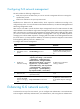
To configure BFD for IS-IS:
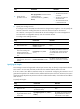
Ste
p
Command
Remarks
1. Enter system view.
system-view N/A
2. Enter interface view.
interface interface-type interface-number N/A
3. Enable IS-IS on an interface.
isis enable [ process-id ] N/A
4. Enable BFD on an IS-IS
interface.
isis bfd enable
By default, an IS-IS interface
is not enabled with BFD.
Configuring IS-IS FRR
A link or router failure on a path can cause packet loss and routing loop. IS-IS FRR uses BFD to detect
failures and enables fast rerouting to minimize the failover time.
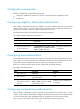
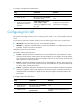
Figure 38 Network diagram for IS-IS FRR
In Figure 38, after you enable FRR on Router B, IS-IS automatically calculates or designates a backup next
hop when a link failure is detected. In this way, packets are directed to the backup next hop to reduce