
R211x-HP Flexfabric 11900 Layer 3 - IP Services Configuration Guide

134
• RFC 3307, Allocation Guidelines for IPv6 Multicast Addresses
• R FC 3 513 , Internet Protocol Version 6 (IPv6) Addressing Architecture
• R F C 4191, Default Router Preferences and More-Specific Routes
• RFC 4861, Neighbor Discovery for IP Version 6 (IPv6)
• RFC 4862, IPv6 Stateless Address Autoconfiguration
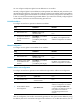
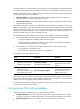
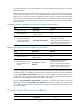
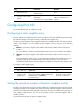
IPv6 basics configuration task list
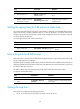
Tasks at a
g
lance
(Required.) Assigning IPv6 addresses to interfaces:
• Configuring an IPv6 global unicast address
• Configuring an IPv6 link-local address
• Configuring an IPv6 anycast address
(Optional.) Configuring IPv6 ND:
• Configuring a static neighbor entry
• Setting the maximum number of dynamic neighbor entries
• Setting the aging timer for ND entries in stale state
• Minimizing link-local ND entries
• Setting the hop limit
• Configuring parameters for RA messages
• Configuring the maximum number of attempts to send an NS message for DAD
(Optional.) Controlling sending ICMPv6 messages:
• Configuring the rate limit for ICMPv6 error messages
• Enabling replying to multicast echo requests
• Enabling sending ICMPv6 destination unreachable messages
• Enabling sending ICMPv6 time exceeded messages
• Enabling sending ICMPv6 redirect messages
• Specifying the source address for ICMPv6 packets
Assigning IPv6 addresses to interfaces
This section describes how to configure an IPv6 global unicast address, an IPv6 link-local address, and
an IPv6 anycast address.
Configuring an IPv6 global unicast address
Use one of the following methods to configure an IPv6 global unicast address for an interface:
• EUI-64 IPv6 address—The IPv6 address prefix of the interface is manually configured, and the
interface identifier is generated automatically by the interface.
• Manual configuration—The IPv6 global unicast address is manually configured.
• Stateless address autoconfiguration—The IPv6 global unicast address is generated automatically
based on the address prefix information contained in the RA message.