
R211x-HP Flexfabric 11900 Layer 3 - IP Services Configuration Guide

135
You can configure multiple IPv6 global unicast addresses on an interface.
Manually configured global unicast addresses (including EUI-64 IPv6 addresses) take precedence over
automatically generated ones. If you manually configure a global unicast address with the same address
prefix as an existing global unicast address on an interface, the manually configured one takes effect, but
it does not overwrite the automatically generated address. If you remove the manually configured global
unicast address, the device uses the automatically generated one.
EUI-64 IPv6 address
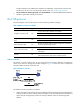
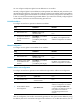
To configure an interface to generate an EUI-64 IPv6 address:
Ste
p
Command
Remarks
1. Enter system view.
system-view N/A
2. Enter interface view.
interface interface-type
interface-number
N/A
3. Configure the interface to
generate an EUI-64 IPv6
address.
ipv6 address { ipv6-address
prefix-length |
ipv6-address/prefix-length }
eui-64
By default, no IPv6 global unicast
address is configured on an interface.
Manual configuration
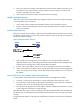
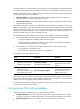
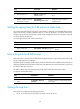
To configure an IPv6 global unicast address for an interface:
Ste
p
Command
Remarks
1. Enter system view.
system-view N/A
2. Enter interface view.
interface interface-type
interface-number
N/A
3. Configure an IPv6 global
unicast address for the
interface.
ipv6 address { ipv6-address
prefix-length |
ipv6-address/prefix-length }
By default, no IPv6 global unicast
address is configured on an interface.
Stateless address autoconfiguration
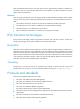
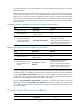
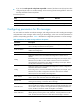
To configure an interface to generate an IPv6 address through stateless address autoconfiguration:
Ste
p
Command
Remarks
1. Enter system view.
system-view N/A
2. Enter interface view.
interface interface-type
interface-number
N/A
3. Enable stateless address
autoconfiguration.
ipv6 address auto
By default, no IPv6 global unicast
address is configured on an interface.
Using the undo ipv6 address auto
command on an interface removes all
IPv6 global unicast addresses
automatically generated on the
interface.
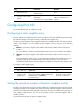
After this configuration, the interface automatically generates an IPv6 global unicast address by using
the address prefix in the received RA message and the interface ID. On an IEEE 802 interface (such as