
R211x-HP Flexfabric 11900 MPLS Command Reference


16
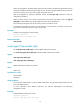
some special scenarios. For example, when OAM is configured on the egress, the egress can get the
OAM function entity status only through non-null labels.
As a penultimate hop, the device accepts the implicit null label, explicit null label, or normal label
advertised by the egress device.
For LDP LSPs, the mpls label advertise command triggers LDP to delete the LSPs established before the
command is executed and reestablishes new LSPs.
For BGP LSPs, the mpls label advertise command takes effect only for the BGP LSPs established after the
command is executed. To apply the new setting to BGP LSPs established before the command is executed,
delete the routes corresponding to the BGP LSPs, and then redistribute the routes.
Examples
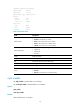
# Configure the egress device to advertise an explicit null label to the penultimate hop.
<Sysname> system-view
[Sysname] mpls label advertise explicit-null
Related commands
reset mpls ldp
mpls lsr-id
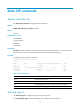
Use mpls lsr-id to configure an LSR ID for the local LSR.
Use undo mpls lsr-id to delete the LSR ID of the local LSR.
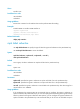
Syntax
mpls lsr-id lsr-id
undo mpls lsr-id
Default
An LSR has no LSR ID.
Views
System view
Predefined user roles
network-admin
mdc-admin
Parameters
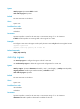
lsr-id: Specifies an ID for identifying the LSR, in dotted decimal notation.
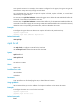
Usage guidelines
HP recommends that you use the address of a loopback interface on the LSR as the LSR ID.
Examples
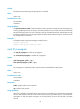
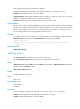
# Configure the LSR ID as 3.3.3.3 for the local node.
<Sysname> system-view
[Sysname] mpls lsr-id 3.3.3.3
Related commands
lsr-id