
R211x-HP Flexfabric 11900 MPLS Configuration Guide
175
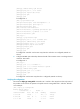
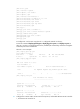
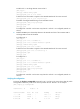
Routing Tables: Public
Destinations : 11 Routes : 11
Destination/Mask Proto Pre Cost NextHop Interface
1.1.1.9/32 Direct 0 0 127.0.0.1 InLoop0
2.2.2.9/32 ISIS 15 10 10.1.1.2 Vlan12
5.5.5.9/32 ISIS 15 84 10.1.1.2 Vlan12
6.6.6.9/32 ISIS 15 84 10.1.1.2 Vlan12
10.1.1.0/24 Direct 0 0 10.1.1.1 Vlan12
10.1.1.1/32 Direct 0 0 127.0.0.1 InLoop0
10.1.1.2/32 Direct 0 0 10.1.1.2 Vlan12
11.1.1.0/24 ISIS 15 20 10.1.1.2 Vlan12
20.1.1.0/24 ISIS 15 84 10.1.1.2 Vlan12
21.1.1.0/24 ISIS 15 84 10.1.1.2 Vlan12
21.1.1.2/32 ISIS 15 84 10.1.1.2 Vlan12
127.0.0.0/8 Direct 0 0 127.0.0.1 InLoop0
127.0.0.1/32 Direct 0 0 127.0.0.1 InLoop0
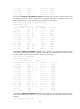
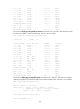
# Execute the display ip routing-table vpn-instance command on PE 3 and PE 4. The output shows that
the routes of the remote VPN customers are present in the VPN routing tables. Take PE 3 as an example:
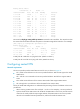
[PE3] display ip routing-table vpn-instance vpn1
Routing Tables: vpn1
Destinations : 3 Routes : 3
Destination/Mask Proto Pre Cost NextHop Interface
100.1.1.0/24 Direct 0 0 100.1.1.2 Vlan11
100.1.1.2/32 Direct 0 0 127.0.0.1 InLoop0
120.1.1.0/24 BGP 255 0 6.6.6.9 NULL0
# Verify that PE 3 and PE 4 can ping each other. (Details not shown.)
# Verify that CE 3 and CE 4 can ping each other. (Details not shown.)
Configuring nested VPN
Network requirements
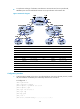
The service provider provides nested VPN services for users, as shown in Figure 53.
• PE 1 and PE 2 are PE devices on the service provider backbone. Both of them support the nested
VPN function.
• CE 1 and CE 2 are connected to the service provider backbone. Both of them support VPNv4
routes.
• PE 3 and PE 4 are PE devices of the customer VPN. Both of them support MPLS L3VPN.
• CE 3 through CE 6 are CE devices of the sub-VPNs for the customer VPN.
The key of nested VPN configuration is to understand the processing of routes of sub-VPNs on the service
provider PEs:
• When receiving a VPNv4 route from a CE (CE 1 or CE 2 in this example), a service provider PE
replaces the RD of the VPNv4 route with the RD of the MPLS VPN on the service provider network
where the CE resides, adds the export target attribute of the MPLS VPN on the service provider
network to the extended community attribute list, and then forwards the VPNv4 route.