
R211x-HP Flexfabric 11900 MPLS Configuration Guide


233
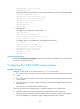
[PE2-bgp-vpnv6] peer 2.2.2.9 enable
[PE2-bgp-vpnv6] quit
# Configure 2002::2 as an EBGP peer, and redistribute BGP routes to the routing table of vpn1.
[PE2-bgp] ip vpn-instance vpn1
[PE2-bgp-vpn1] peer 2002::2 as-number 65002
[PE2-bgp-vpn1] address-family ipv6 unicast
[PE2-bgp-ipv6-vpn1] peer 2002::2 enable
[PE2-bgp-ipv6-vpn1] quit
[PE2-bgp-vpn1] quit
[PE2-bgp] quit
6. Configure CE 2:
# Configure an IPv6 address for VLAN-interface 12.
<CE2> system-view
[CE2] interface vlan-interface 12
[CE2-Vlan-interface12] ip address 2002::2 64
[CE2-Vlan-interface12] quit
# Configure 2002::1 as an EBGP peer, and redistribute direct routes.
[CE2] bgp 65002
[CE2-bgp] peer 2002::1 as-number 600
[CE2-bgp] address-family ipv6 unicast
[CE2-bgp-ipv6] peer 2002::1 enable
[CE2-bgp-ipv6] import-route direct
[CE2-bgp-ipv6] quit
[CE2-bgp] quit
Verifying the configuration
# Execute the display ipv6 routing-table command on CE 1 and CE 2 to display routes to each other. CE
1 and CE 2 can ping each other.
Configuring IPv6 MPLS L3VPN carrier's carrier
Network requirements
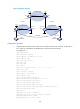
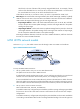
Configure carrier's carrier for the scenario shown in Figure 62. In this scenario:
• PE 1 and PE 2 are the provider carrier's PE switches. They provide VPN services for the customer
carrier.
• CE 1 and CE 2 are the customer carrier's switches. They connect to the provider carrier's backbone
as CE switches.
• PE 3 and PE 4 are the customer carrier's PE switches. They provide IPv6 MPLS L3VPN services for
end customers.
• CE 3 and CE 4 are customers of the customer carrier.
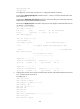
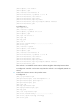
The key to the carrier's carrier deployment is to configure exchange of two kinds of routes:
• Exchange of the customer carrier's internal routes on the provider carrier's backbone.
• Exchange of the end customers' internal routes between PE 3 and PE 4, the PEs of the customer
carrier. An MP-IBGP peer relationship must be established between PE 3 and PE 4.