
R211x-HP Flexfabric 11900 MPLS Configuration Guide

243
a PW ID and a PW type to identify a PW. The PW ID is the ID of the PW between PEs. The PW type
specifies the encapsulation type for data transmitted over the PW, such as ATM, FR, Ethernet, or
VLAN. PEs advertise the PW label and PW ID FEC in label mapping messages to create a PW.
Dynamic PWs have simple configurations but consume more resources than static PWs.
To establish BGP PWs, BGP advertises label block information in an extended BGP update to PEs
in the same VPN. Each PE uses the received label block information to calculate outgoing labels
and uses its own label block to calculate incoming labels. After two PEs complete label calculation,
a BGP PW is established between them. BGP PWs have the following benefits:
{ Simplified configuration—There is no need to manually specify peer PEs. A PE automatically
find peer PEs after receiving label block information from the peer PEs.
{ Reduced workload—Label block advertisement enables assigning labels for multiple PWs at
one time.
3. Set up an AC between a PE and a CE:
Set up an AC by configuring a link layer connection between a PE and a CE.
An AC is a service instance on a Layer 2 Ethernet interface or Layer 2 aggregate interface. The
interface forwards incoming packets that match the service instance to the bound PW.
4. Bind the AC to the PW:
Bind the service instance to the PW, so the PE forwards packets between the AC and the PW.
PW redundancy
PW redundancy provides redundant links between PEs so that the customer networks can communicate
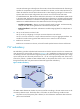
when the path over one PW fails. As shown in Figure 64, P
E 1 establishes two PWs (one primary and
one backup). The CEs communicate through the primary PW. When the primary PW fails, PE 1 brings
up the backup PW and forwards packets from CE 1 to CE 2 through the backup PW. When CE 2
receives the packets, it updates its MAC address table, so that packets from CE 2 to CE 1 also travel
through the backup PW. Only static PWs and LDP PWs support PW redundancy.
Figure 64 PW redundancy
The MPLS L2VPN determines whether the primary PW fails according to the LDP session status or the
connectivity detection result. The backup PW is used when one of the following conditions exists:
• The public tunnel of the primary PW is deleted, or the link detection mechanism detects that the
public tunnel has failed.