
R211x-HP Flexfabric 11900 MPLS Configuration Guide

45
Dynamic CRLSP establishment
Dynamic CRLSPs are dynamically established through a label distribution protocol (such as RSVP-TE). The
label distribution protocol advertises labels to establish CRLSPs and reserves bandwidth resources on
each node along the calculated path.
Dynamic CRLSPs adapt to network changes and support CRLSP backup, but they require complicated
configurations.
The device supports the label distribution protocol of RSVP-TE for MPLS TE. Resource Reservation Protocol
(RSVP) reserves resources on each node along a path. Extended RSVP can support MPLS label
distribution and allow resource reservation information to be transmitted with label bindings. This
extended RSVP is called "RSVP-TE."
For more information about RSVP, see "Configuring RSVP."
Traffic forwarding
After an MPLS TE tunnel is established, traffic is not forwarded on the tunnel automatically. You must
direct the traffic to the tunnel by creating a static route that reaches the destination through the tunnel
interface.
This is the easiest way to implement MPLS TE tunnel forwarding. However, when the traffic to multiple
networks is to be forwarded through the MPLS TE tunnel, you must configure multiple static routes, which
are complicated to configure and difficult to maintain.
For more information about static routing, see Layer 3—IP Routing Configuration Guide.
Make-before-break
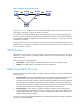
Make-before-break is a mechanism to change an MPLS TE tunnel with minimum data loss and without
using extra bandwidth.
Traffic forwarding is interrupted if the existing CRLSP is removed before a new CRLSP is established. The
make-before-break mechanism makes sure that the existing CRLSP is removed after the new CRLSP is
established and the traffic is switched to the new CRLSP. However, this might waste bandwidth resources
if some links on the old and new CRLSPs are the same, because you need to reserve bandwidth on these
links for both the old and new CRLSPs. The make-before-break mechanism uses the SE resource
reservation style to address this problem.
The resource reservation style refers to the style in which RSVP-TE reserves bandwidth resources during
CRLSP establishment. The resource reservation style used by an MPLS TE tunnel is determined by the
ingress node, and is advertised to other nodes through RSVP.
The device supports the following resource reservation styles:
• FF—Fixed-filter, where resources are reserved for individual senders and cannot be shared among
senders on the same session.
• SE—Shared-explicit, where resources are reserved for senders on the same session and shared
among them. SE is mainly used for make-before-break.