
R211x-HP Flexfabric 11900 MPLS Configuration Guide


46
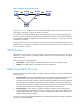
Figure 19 Diagram for make-before-break
As shown in Figure 19, a CRLSP with 30 M reserved bandwidth has been set up from Router A to Router
D through the path Router A—Router B—Router C—Router D.
To increase the reserved bandwidth to 40 M, a new CRLSP must be set up through the path Router A—
—Router E—Router C—Router D. To achieve this purpose, RSVP-TE needs to reserve 30M bandwidth for
the old CRLSP and 40M bandwidth for the new CRLSP on the link Router C—Router D, but the link
bandwidth is not enough.
Using the make-before-break mechanism, the new CRLSP can share the bandwidth reserved for the old
CRLSP. After the new CRLSP is set up, traffic is switched to the new CRLSP without service interruption, and
then the old CRLSP is removed.
CRLSP backup
CRLSP backup uses a CRLSP to back up a primary CRLSP. When the ingress detects that the primary
CRLSP fails, it switches traffic to the backup CRLSP. When the primary CRLSP recovers, the ingress
switches traffic back.
CRLSP backup has the following modes:
• Hot standby—A backup CRLSP is created immediately after a primary CRLSP is created.
• Ordinary—A backup CRLSP is created after the primary CR-LSP fails.
Bidirectional MPLS TE tunnel
A bidirectional MPLS TE tunnel includes two CRLSPs in opposite directions. It can be established in the
following modes:
• Co-routed mode—Uses the extended RSVP-TE protocol to establish a bidirectional MPLS TE tunnel.
RSVP-TE uses a Path message to advertise the labels assigned by the upstream LSR to the
downstream LSR and a Resv message to advertise the labels assigned by the downstream LSR to the
upstream LSR. During the delivery of the path message, a CRLSP in one direction is established.
During the delivery of the Resv message, a CRLSP in the other direction is established. The CRLSPs
of a bidirectional MPLS TE tunnel established in co-routed mode use the same path.
• Associated mode—In this mode, you establish a bidirectional MPLS TE tunnel by binding two
unidirectional CRLSPs in opposite directions. The two CRLSPs can be established in different modes
and use different paths. For example, one CRLSP is established statically and the other CRLSP is
established dynamically by RSVP-TE.
For more information about establishing MPLS TE tunnel through RSVP-TE, the Path message, and the Resv
message, see "Configuring RSVP."