
R211x-HP Flexfabric 11900 Network Management and Monitoring Configuration Guide
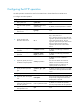
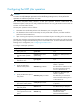
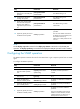


105
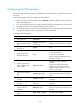
Configuring the UDP jitter operation
CAUTION:
To ensure successful UDP jitter operations and avoid affecting existing services, do not perform the
operations on well-known ports from 1 to 1023.
Jitter means inter-packet delay variance. A UDP jitter operation measures unidirectional and
bidirectional jitters so that you can verify whether the network can carry jitter-sensitive services such as
real-time voice and video services.
The UDP jitter operation works as follows:
1. The NQA client sends UDP packets to the destination port at a regular interval.
2. The destination device takes a time stamp to each packet that it receives, and then sends the
packet back to the NQA client.
3. Upon receiving the responses, the NQA client calculates the jitter according to the time stamps.
The UDP jitter operation requires both the NQA server and the NQA client. Before you perform the UDP
jitter operation, configure the UDP listening service on the NQA server. For more information about UDP
listening service configuration, see "Configuring the NQA server."
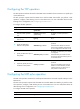
T
o configure a UDP jitter operation:
Ste
p
Command
Remarks
1. Enter system view.
system-view N/A
2. Create an NQA operation
and enter NQA operation
view.
nqa entry admin-name
operation-tag
By default, no NQA operation is
created.
3. Specify the UDP jitter type
and enter its view.
type udp-jitter N/A
4. Specify the destination
address of UDP packets.
destination ip ip-address
By default, no destination IP
address is specified.
The destination IP address must be
the same as that of the listening
service on the NQA server.
5. Specify the destination port of
UDP packets.
destination port port-number
By default, no destination port
number is specified.
The destination port must be the
same as that of the listening service
on the NQA server.
6. (Optional.) Specify the source
port number of UDP packets.
source port port-number
By default, no source port number
is specified.
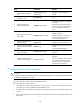
7. Specify the payload size in
each UDP packet.
data-size size The default setting is 100 bytes.
8. Specify the string to be filled
in the payload of each UDP
packet.
data-fill string
The default setting is the
hexadecimal number
00010203040506070809.