
R211x-HP Flexfabric 11900 Network Management and Monitoring Configuration Guide

160
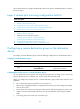
Ste
p
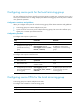
Command
Remarks
1. Enter system view.
system-view N/A
2. Enter interface view.
interface interface-type
interface-number
N/A
3. Configure the port as a source
port for the specified remote
source group.
mirroring-group group-id
mirroring-port { both | inbound |
outbound }
By default, a port does not serve as
a source port for any remote
source group.
Configuring source CPUs for a remote source group
A mirroring group can contain multiple source CPUs.
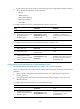
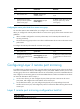
To configure source CPUs for a remote source group:
Ste
p
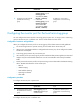
Command
Remarks
1. Enter system view.
system-view N/A
2. Configure source CPUs for the
specified remote source
group.
• In standalone mode:
mirroring-group group-id
mirroring-cpu slot
slot-number-list { both |
inbound | outbound }
• In IRF mode:
mirroring-group group-id
mirroring-cpu chassis
chassis-number slot
slot-number-list { both |
inbound | outbound }
By default, no source CPU is
configured for a remote source
group.
Configuring the egress port for a remote source group
You can configure the egress port for a mirroring group in system view, or assign a port to it as the egress
port in interface view. The two configuration modes lead to the same result.
When you configure the egress port for a remote source group, follow these restrictions and guidelines:
• Disable these functions on the egress port: the spanning tree feature, 802.1X, IGMP snooping,
static ARP, and MAC address learning.
• A mirroring group contains only one egress port.
• A port of an existing mirroring group cannot be configured as an egress port.
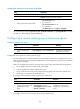
To configure the egress port for a remote source group in system view:
Ste
p
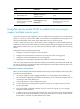
Command
Remarks
1. Enter system view.
system-view N/A
2. Configure the egress port for
the specified remote source
group.
mirroring-group group-id
monitor-egress interface-type
interface-number
By default, no egress port is
configured for a remote source
group.
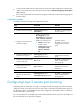
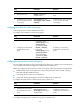
To configure the egress port for a remote source group in interface view: