
R211x-HP Flexfabric 11900 Network Management and Monitoring Configuration Guide

13
in the NTP message. If they are the same, the receiver accepts the message. Otherwise, it discards
the message.
NTP for MPLS VPNs
The device supports multiple VPN instances when it functions as an NTP client or a symmetric active peer
to realize time synchronization with the NTP server or symmetric passive peer in an MPLS VPN network.
Only the client/server and symmetric active/passive modes support VPN instances. For more
information about MPLS L3VPN, VPN instance, and PE, see MPLS Configuration Guide.
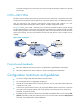
As Figure 8 sho
ws, users in VPN 1 and VPN 2 are connected to the MPLS backbone network through
provider edge (PE) devices, and services of the two VPNs are isolated. If you configure the PEs to operate
in NTP client or symmetric active mode, and specify the VPN to which the NTP server or NTP symmetric
passive peer belongs, the time synchronization between PEs and devices of the two VPNs can be
realized.
Figure 8 Network diagram
Protocols and standards
• RFC 1305, Network Time Protocol (Version 3) Specification, Implementation and Analysis
• RFC 5905, Network Time Protocol Version 4: Protocol and Algorithms Specification
Configuration restrictions and guidelines
• You cannot configure both NTP and SNTP on the same device.
• Do not configure NTP on an aggregate member port.
• The NTP service and SNTP service are mutually exclusive. You can only enable either NTP service
or SNTP service at a time.
• To ensure time synchronization accuracy, do not specify different reference sources for a symmetric
active peer and a symmetric passive peer if they operate as the NTP client for the client/server,
broadcast, and multicast modes.
• By default, the device uses the NTP time source specified on the default MDC. You can use the clock
protocol command to specify the system time source. For more information about the clock protocol
command, see Fundamentals Command Reference.