
R211x-HP Flexfabric 11900 OAA Configuration Guide

1
Configuring OAP
Overview
HP Open Application Platform (OAP) is an open application protocol that is based on HP Open
Application Architecture (OAA). OAA is intended for products from different vendors to operate as a
whole to meet emerging service requirements.
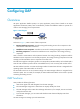
Figure 1 OAA diagram
As shown in Figure 1, OAA consists of three components:
• Routing/switching component—Provides routing and switching services. This component is the
control center of the entire architecture.
• Standalone service component—Provides new services for meeting emerging service requirements.
• Interfacing component—Connects the standalone service component to the routing/switching
component.
OAP is used for communication and cooperation between the routing/switching component and the
standalone service component. From the OAP perspective, the routing/switching component is the OAP
manager, and the standalone service component is the OAP client.
The OAP client might be a third-party product or an HP product (HP OAP module). HP has developed a
series of OAP modules to provide various value-added services, such as security and wireless control.
HP OAP modules have their own CPUs and storage media. The OAP client software is integrated in the
operating system of the OAP module as a function.
The HP 11900 switch can act as the OAP manager. The OAP manager software is integrated in the
Comware system. You can install, for example, the OAP module LSU1FWCEA in the switch to provide
monitoring and testing services.
OAP functions
OAP provides the following functions:
• OAP clients register with and deregister from the OAP manager.
• The OAP manager assigns IDs to OAP clients to uniquely identify the clients.
• The OAP manager and an OAP client exchange information to, for example, monitor each other
and synchronize the clock.
• From the OAP manager, you can restart and shutdown OAP clients and display OAP client
information.
An OAP manager can manage up to 255 OAP clients.