
R211x-HP Flexfabric 11900 Security Configuration Guide



246
• Pair-wise consistency test—This test is run when a DSA/RSA asymmetrical key-pair is generated. It
uses the public key to encrypt a plain text, and uses the private key to decrypt the encrypted text. If
the decryption is successful, the test succeeds. Otherwise, the test fails.
• Continuous random number generator test—This test is run when a random number is generated.
If two consecutive random numbers are different, the test succeeds. Otherwise, the test fails. This test
can also be run when a DSA/RSA asymmetrical key-pair is generated.
Triggering self-tests
To examine whether the cryptography modules operate correctly, you can trigger a self-test on the
cryptographic algorithms. The triggered self-test is the same as the power-up self-test. If the self-test fails,
the card where the self-test process exists reboots.
To trigger a self-test:
Ste
p
Command
1. Enter system view.
system-view
2. Trigger a self-test.
fips self-test
Displaying and maintaining FIPS
Execute the display command in any view.
Task Command
Display the FIPS mode state. display fips status
FIPS configuration examples
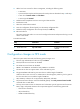
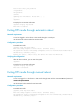
Entering FIPS mode through automatic reboot
Network requirements
Use the automatic reboot method to enter FIPS mode, and use a console port to log in to the device in
FIPS mode.
Configuration procedure
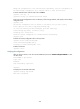
# If you want to save the current configuration, execute the save command before you enable FIPS mode.
# Enable FIPS mode and choose the automatic reboot method to enter FIPS mode. Configure the
username as root and the password as 123 45 z xc vb ! @# $% Z XC VB .
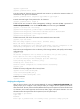
<Sysname> system-view
[Sysname] fips mode enable
FIPS mode change requires a device reboot. Continue? [Y/N]:y
Reboot the device automatically? [Y/N]:y
The system will create a new startup configuration file for FIPS mode. After you set the
login username and password for FIPS mode, the device will reboot automatically.