
R211x-HP Flexfabric 11900 Security Configuration Guide

42
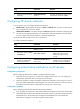
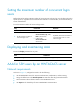
Ste
p
Command
Remarks
3. Return to system view.
quit N/A
4. (Optional.) Specify the default
ISP domain.
domain default enable
isp-name
By default, the default ISP domain is the
system-defined ISP domain system.
Configuring ISP domain attributes
In an ISP domain, you can configure the following attributes:
• Domain status—By placing the ISP domain in active or blocked state, you allow or deny network
service requests from users in the domain.
• Authorization attributes—The device assigns the idle-cut authorization attributes configured in the
ISP domain to the authenticated users. If no authorization attribute is available in the ISP domain,
the server assigns authorization attributes to the authenticated users.
An ISP domain attribute applies to all users in the domain.
To configure ISP domain attributes:
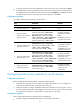
Ste
p
Command
Remarks
1. Enter system view.
system-view N/A
2. Enter ISP domain view.
domain isp-name N/A
3. Place the ISP domain in active
or blocked state.
state { active | block }
By default, an ISP domain is in
active state, and users in the
domain can request network
services.
4. Configure authorization
attributes for authenticated
users in the ISP domain.
authorization-attribute idle-cut
minute [ flow ]
By default, the authorization
attributes are not configured and
the idle cut function is disabled.
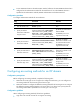
Configuring authentication methods for an ISP domain
Configuration prerequisites
Before configuring authentication methods, complete the following tasks:
1. Determine the access type or service type to be configured. With AAA, you can configure an
authentication method for each access type and service type.
2. Determine whether to configure the default authentication method for all access types or service
types. The default authentication method applies to all access users, but it has a lower priority than
the authentication method that is specified for an access type or service type.
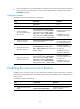
Configuration guidelines
When configuring authentication methods, follow these guidelines:
• If you configure an authentication method that references a RADIUS scheme and an authorization
method that does not reference a RADIUS scheme, AAA accepts only the authentication result from
the RADIUS server. The Access-Accept message from the RADIUS server also includes the
authorization information, but the device ignores the information.