
R211x-HP Flexfabric 11900 TRILL Configuration Guide



11
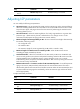
Ste
p
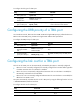
Command
Remarks
2. Configure an
LSU1TGS48SF0 card to
operate in port-extender
mode (in standalone mode).
switch-mode port-extender slot
slot-number
By default, the LSU1TGS48SF0
card operates in normal mode.
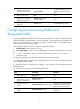
3. Configure an
LSU1TGS48SF0 card to
operate in port-extender
mode (in IRF mode).
switch-mode port-extender chassis
chassis-number slot slot-number
By default, the LSU1TGS48SF0
card operates in normal mode.
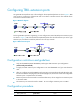
Configuring TRILL timers
You can configure the following TRILL timers:
• Hello interval and Hello multiplier—An RB advertises Hello frames at the Hello interval to maintain
a TRILL adjacency. The shorter the Hello interval, the faster the network convergence. However, a
shorter Hello interval consumes more system resources. The adjacency holding time is obtained by
multiplying the Hello interval by the Hello multiplier. The RB advertises the adjacency holding time
to neighbors through Hello frames. If a neighbor does not receive any Hello frame from the RB
before the adjacency holding time expires, it removes the TRILL adjacency with the RB.
• Inhibition time—An RB that acts as the AVF of a VLAN guarantees that frames from the VLAN have
only one incoming port or one outgoing port along a link. When other RBs receive frames from the
VLAN, they do not perform any processing. However, when the RB detects that a root bridge
change occurs on a link or that the AVF advertised by other RBs conflicts with the local AVF, the RB
inhibits the local AVF for a certain time to avoid loops. When the inhibition time expires, if the RB
is still the AVF of the VLAN, the RB restores the role of AVF.
• CSNP interval—On a broadcast network, the DRB advertises CSNPs at the CSNP interval to
perform network-wide LSDB synchronization. A CSNP records all LSP digests of the local LSDB.
When an RB receives a CSNP, the RB compares the CSNP against the local LSDB to verify whether
some LSPs are aged out or missing. If the CSNP has an LSP digest that the local LSDB does not have,
the RB sends a PSNP packet to request the LSP.
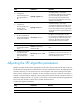
To configure TRILL timers:
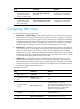
Step Command Remarks
1. Enter system view.
system-view N/A
2. Enter Layer 2 Ethernet
or aggregate interface
view.
interface interface-type
interface-number
N/A
3. Configure the Hello
interval.
trill timer hello interval
The default setting is 10 seconds.
This command sets the Hello interval for the
RB. The Hello interval of the DRB is 1/3 of the
Hello interval of the RB, so that the DRB
failures can be quickly detected.
4. Configure the Hello
multiplier.
trill timer holding-multiplier
count
The default setting is 3.
5. Configure the inhibition
time.
trill timer avf-inhibited time The default setting is 30 seconds.