
R21xx-HP FlexFabric 11900 FCoE Configuration Guide



26
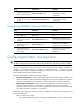
Ste
p
Command
Remarks
3. Configure the global error
detection timeout period.
fc timer error-detect value
By default, the error detection
timeout period is 2000
milliseconds.
4. Configure the global
resource allocation timeout
period.
fc timer resource-allocation value
By default, the resource allocation
timeout period is 10000
milliseconds.
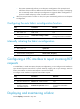
Configuring the fabric timers in VSAN view
Ste
p
Command
Remarks
1. Enter system view.
system-view N/A
2. Enter VSAN view. vsan vsan-id N/A
3. Configure the distributed
service timeout period for
the VSAN.
timer distributed-services value
By default, the distributed service
timeout period is 5000 milliseconds.
4. Configure the error
detection timeout period
for the VSAN.
timer error-detect value
By default, the error detection
timeout period is 2000 milliseconds.
5. Configure the resource
allocation timeout period
for the VSAN.
timer resource-allocation value
By default, the resource allocation
timeout period is 10000
milliseconds.
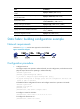
Configuring the fabric reconfiguration
IMPORTANT:
The fabric reconfiguration function takes effects only when the fabric configuration function is enabled.
The fabric reconfiguration occurs in the case of a network reconstruction (for example, two fabrics are
merged) or external intervention (for example, the administrator uses a command to initiate
reconfiguration). The fabric reconfiguration triggers principal switch selection, domain ID assignment,
and FC address assignment throughout the fabric.
The fabric reconfiguration includes the following categories:
• Disruptive reconfiguration—Floods the Reconfigure Fabric (RCF) frames throughout the fabric, and
notifies all switches to perform a disruptive reconfiguration. During the reconfiguration procedure,
each switch clears all data for renegotiation, and data transmission in the fabric is disrupted.
• Non-disruptive reconfiguration—Floods the Build Fabric (BF) frames throughout the fabric, and
notifies all switches to perform a non-disruptive reconfiguration. During the reconfiguration
procedure, each switch tries to save the last running data for its domain ID to remain unchanged.
Thus, data transmission in the fabric is not disrupted.
Depending on the triggering conditions, the fabric reconfiguration includes auto reconfiguration and
manual reconfiguration.
• When two fabrics are merged:
{ The switches automatically perform a disruptive reconfiguration if the domain ID lists overlap.