
R21xx-HP FlexFabric 11900 FCoE Configuration Guide

37
Configuring VSAN
Overview
The virtual storage area network (VSAN) technology breaks a physical SAN into multiple VSANs, and
provides more secure, reliable, and flexible services.
Devices in a VSAN cannot get information about any other VSAN and devices in any other VSAN. Each
VSAN performs the following operations independently: selecting a principal switch, assigning domain
IDs, running routing protocols, maintaining routing table and FIB table, and providing services.
The VSAN technology delivers the following benefits:
• Improved security—VSANs are isolated from each other.
• Improved adaptability—Each VSAN independently runs and provides services. Different VSANs
can use the same address space so that network capacity is improved.
• Flexibility—You can assign interfaces to different VSANs without changing the physical
connections of the SAN.
VSAN fundamentals
VFC interfaces can only work as trunk ports. A trunk port can belong to multiple VSANs.
Trunk VSAN in an FC network
The trunk VSAN technology implements logical isolation among VSANs. The trunk VSAN works as
follows: The trunk VSAN adds a Virtual Fabric Tagging Header (VFT_Header, also known as VSAN tag)
to the FC frames. The VFT_Header contains a VF_ID (also known as "VSAN ID") field to indicate the
VSAN of the FC frames. In this way, FC frames within different VF_IDs are contained in their respective
VSANs, and different VSANs cannot communicate with each other. VSAN tags are added to and
removed from an FC frame during transmission. A switch supports multiple VSANs one physical interface,
thus reducing physical connections and implementing logical isolation in a physically connected SAN.
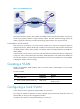
Figure 16 sh
ows a typical trunk VSAN. The F_Ports in blue on switches are configured as trunk ports and
assigned to VSAN 1, and the F_Ports in purple are configured as trunk ports and assigned to VSAN 2.
The E_Ports are configured with trunk VSANs 1 and 2.
When servers read the disks, the N_Ports of different servers send FC frames without VFT_Headers to the
F_Ports on FC switch Switch A. Switch A searches for the outgoing interfaces in the FIB table of the VSAN
that each F_Port belongs to. These F_Ports use the same E_Port as the outgoing interface. When the
frames are forwarded out of the E_Port, they are tagged with the VFT_Header of VSAN 1 and VSAN 2
and travel across multiple VSAN-capable switches to the E_Port of FC switch Switch B.
According to the VFT_Headers, Switch B searches for the outgoing interfaces in the FIB tables of the
VSANs, and forwards them to the F_Ports. Then, the F_Ports remove the VFT_Headers and send the
frames to the N_Ports of different disk devices. The frames from the disk devices to the server are
processed in the same way and finally reach the servers.