
R21xx-HP FlexFabric 11900 FCoE Configuration Guide

3
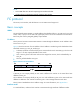
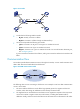
Figure 3 Port modes
• A node has the following interface modes:
{ N_Port—Directly connects to a fabric.
{ NL_Port—Connects to a fabric through an arbitrated loop.
• An FCF switch provides the following port modes:
{ F_Port—Connects to an N_Port or an NP_Port on another FCF switch.
{ E_Port—Connects to an E_Port on another FCF switch.
{ NP_Port—Connects to an F_Port on another FCF switch. For more information about NP_Port,
see "Configuring NPV."
E_Port
s connect FCF switches to form a fabric, and F_Ports connect the nodes to FCF switches in the
fabric.
Communication flow
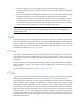
FCF switches provide data transmission services. Through FCF switches, a server sends instructions and
data to disk devices and reads data from disk devices.
Figure 4 FC SAN communication model
The following takes a server accessing a disk device as an example to see how data communication
occurs in an FC SAN.
1. The server and the disk device use the fabric login (FLOGI) protocol to register with the FCF
switches, which then assign FC addresses to each directly-connected node.
2. The registered server and disk device send name service registration requests to their respective
access FCF switches to register name service information, including their WWNs and FC
addresses. Finally, each FCF switch in the fabric stores the name service information for all nodes.