
R21xx-HP FlexFabric 11900 IP Multicast Configuration Guide
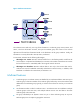


Table Of Contents
- Title Page
- Contents
- Multicast overview
- Configuring IGMP snooping
- Overview
- IGMP snooping configuration task list
- Configuring basic IGMP snooping functions
- Configuring IGMP snooping port functions
- Configuring IGMP snooping policies
- Displaying and maintaining IGMP snooping
- IGMP snooping configuration examples
- Troubleshooting IGMP snooping
- Configuring multicast routing and forwarding
- Configuring IGMP
- Configuring PIM
- Overview
- Configuring PIM-DM
- Configuring PIM-SM
- Configuring common PIM features
- Displaying and maintaining PIM
- PIM configuration examples
- Troubleshooting PIM
- Configuring MLD snooping
- Overview
- MLD snooping configuration task list
- Configuring basic MLD snooping functions
- Configuring MLD snooping port functions
- Configuring MLD snooping policies
- Displaying and maintaining MLD snooping
- MLD snooping configuration examples
- Troubleshooting MLD snooping
- Configuring IPv6 multicast routing and forwarding
- Configuring MLD
- Configuring IPv6 PIM
- PIM overview
- Configuring IPv6 PIM-DM
- Configuring IPv6 PIM-SM
- Configuring common IPv6 PIM features
- Displaying and maintaining IPv6 PIM
- IPv6 PIM configuration examples
- Troubleshooting IPv6 PIM
- Support and other resources
- Index
3
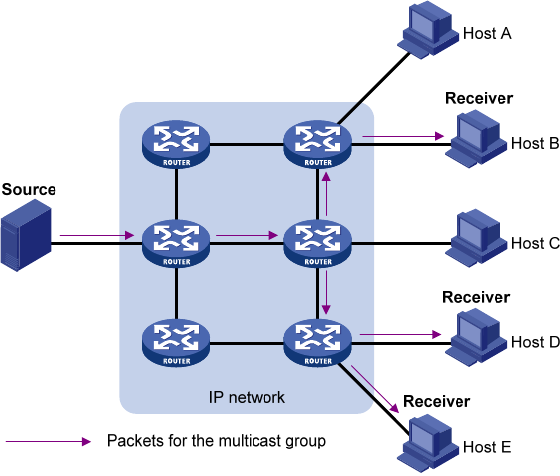
Figure 3 Multicast transmission
The multicast source sends only one copy of the information to a multicast group. Host B, Host D, and
Host E, which are information receivers, must join the multicast group. The routers on the network
duplicate and forward the information based on the distribution of the group members. Finally, the
information is correctly delivered to Host B, Host D, and Host E.
To summarize, multicast has the following advantages:
• Advantages over unicast—Because multicast traffic flows to the farthest-possible node from the
source before it is replicated and distributed, an increase in the number of hosts does not increase
the load of the source or remarkably add to the usage of network resources.
• Advantages over broadcast—Because multicast data is sent only to the receivers that need it,
multicast uses network bandwidth reasonably and enhances network security. In addition, data
broadcast is confined to the same subnet, but multicast is not.
Multicast features
• A multicast group is a multicast receiver set identified by an IP multicast address. Hosts must join a
multicast group to become members of the multicast group before they receive the multicast data
addressed to that multicast group. Typically, a multicast source does not need to join a multicast
group.
• An information sender is called a "multicast source." A multicast source can send data to multiple
multicast groups at the same time, and multiple multicast sources can send data to the same
multicast group at the same time.
• The group memberships are dynamic. Hosts can join or leave multicast groups at any time.
Multicast groups are not subject to geographic restrictions.