
R21xx-HP FlexFabric 11900 IP Multicast Configuration Guide
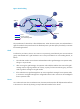

Table Of Contents
- Title Page
- Contents
- Multicast overview
- Configuring IGMP snooping
- Overview
- IGMP snooping configuration task list
- Configuring basic IGMP snooping functions
- Configuring IGMP snooping port functions
- Configuring IGMP snooping policies
- Displaying and maintaining IGMP snooping
- IGMP snooping configuration examples
- Troubleshooting IGMP snooping
- Configuring multicast routing and forwarding
- Configuring IGMP
- Configuring PIM
- Overview
- Configuring PIM-DM
- Configuring PIM-SM
- Configuring common PIM features
- Displaying and maintaining PIM
- PIM configuration examples
- Troubleshooting PIM
- Configuring MLD snooping
- Overview
- MLD snooping configuration task list
- Configuring basic MLD snooping functions
- Configuring MLD snooping port functions
- Configuring MLD snooping policies
- Displaying and maintaining MLD snooping
- MLD snooping configuration examples
- Troubleshooting MLD snooping
- Configuring IPv6 multicast routing and forwarding
- Configuring MLD
- Configuring IPv6 PIM
- PIM overview
- Configuring IPv6 PIM-DM
- Configuring IPv6 PIM-SM
- Configuring common IPv6 PIM features
- Displaying and maintaining IPv6 PIM
- IPv6 PIM configuration examples
- Troubleshooting IPv6 PIM
- Support and other resources
- Index
151
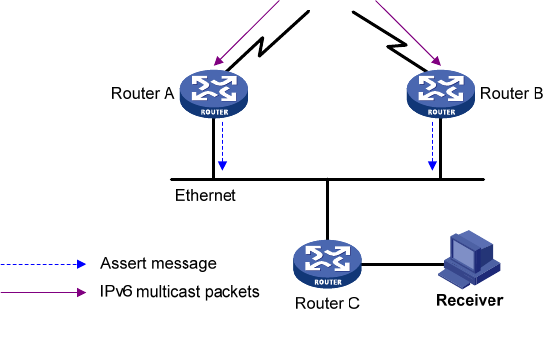
Figure 46 Assert mechanism
As shown in Figure 46, after Router A and Router B receive an (S, G) packet from the upstream node, they
both forward the packet to the local subnet. As a result, the downstream node Router C receives two
identical multicast packets, and both Router A and Router B, on their own downstream interfaces, receive
a duplicate packet forwarded by the other. After detecting this condition, both routers send an assert
message to all IPv6 PIM routers on the local subnet through the interface that received the packet. The
assert message contains the IPv6 multicast source address (S), the IPv6 multicast group address (G), and
the preference and metric of the IPv6 unicast route to the IPv6 multicast source. By comparing these
parameters, either Router A or Router B becomes the unique forwarder of the subsequent (S, G) packets
on the subnet. The comparison process is as follows:
1. The router with a higher preference to the IPv6 multicast source wins.
2. If both routers have the same preference to the IPv6 multicast source, the router with a smaller
metric to the IPv6 multicast source wins.
3. If a tie exists in route metric to the IPv6 multicast source, the router with a higher IPv6 link-local
address on the downstream interface wins.
IPv6 PIM-SM overview
IPv6 PIM-DM uses the flood-and-prune cycles to build SPTs for IPv6 multicast data forwarding. Although
an SPT has the shortest paths from the IPv6 multicast source to the receivers, it is built with a low efficiency
and is not suitable for large- and medium-sized networks.
IPv6 PIM-SM uses the pull mode for IPv6 multicast forwarding, and it is suitable for large-sized and
medium-sized networks with sparsely and widely distributed IPv6 multicast group members.
The basic implementation of IPv6 PIM-SM is as follows:
• IPv6 PIM-SM assumes that no hosts need IPv6 multicast data. In the IPv6 PIM-SM mode, a host must
express its interest in the IPv6 multicast data for an IPv6 multicast group before the data is
forwarded to it. IPv6 PIM-SM implements multicast forwarding by building and maintaining
rendezvous point trees (RPTs). An RPT is rooted at a router that has been configured as the