
R21xx-HP FlexFabric 11900 IP Multicast Configuration Guide

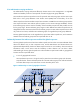
Table Of Contents
- Title Page
- Contents
- Multicast overview
- Configuring IGMP snooping
- Overview
- IGMP snooping configuration task list
- Configuring basic IGMP snooping functions
- Configuring IGMP snooping port functions
- Configuring IGMP snooping policies
- Displaying and maintaining IGMP snooping
- IGMP snooping configuration examples
- Troubleshooting IGMP snooping
- Configuring multicast routing and forwarding
- Configuring IGMP
- Configuring PIM
- Overview
- Configuring PIM-DM
- Configuring PIM-SM
- Configuring common PIM features
- Displaying and maintaining PIM
- PIM configuration examples
- Troubleshooting PIM
- Configuring MLD snooping
- Overview
- MLD snooping configuration task list
- Configuring basic MLD snooping functions
- Configuring MLD snooping port functions
- Configuring MLD snooping policies
- Displaying and maintaining MLD snooping
- MLD snooping configuration examples
- Troubleshooting MLD snooping
- Configuring IPv6 multicast routing and forwarding
- Configuring MLD
- Configuring IPv6 PIM
- PIM overview
- Configuring IPv6 PIM-DM
- Configuring IPv6 PIM-SM
- Configuring common IPv6 PIM features
- Displaying and maintaining IPv6 PIM
- IPv6 PIM configuration examples
- Troubleshooting IPv6 PIM
- Support and other resources
- Index
158
IPv6 administrative scoping mechanism
The administrative scoping mechanism effectively releases stress on the management in a single-BSR
domain and enables provision of zone-specific services through private group addresses.
An IPv6 admin-scoped zone provides services for particular IPv6 multicast groups with the same scope
field value in their group addresses. Zone border routers (ZBRs) form the boundary of an IPv6
admin-scoped zone. Each IPv6 admin-scoped zone maintains one BSR for IPv6 multicast groups with the
same scope field value. IPv6 multicast protocol packets, such as assert messages and BSMs, of these
IPv6 multicast groups cannot cross the boundary of the IPv6 admin-scoped zone that provides services
for the group range. The IPv6 multicast group ranges to which different IPv6 admin-scoped zones are
designated can have intersections, but the IPv6 multicast groups in an IPv6 admin-scoped zone are valid
only within its local zone, and theses IPv6 multicast groups are regarded as private group addresses.
The IPv6 global-scoped zone can be regarded as a special IPv6 admin-scoped zone, and it maintains
a BSR for the IPv6 multicast groups with the scope field value as 14.
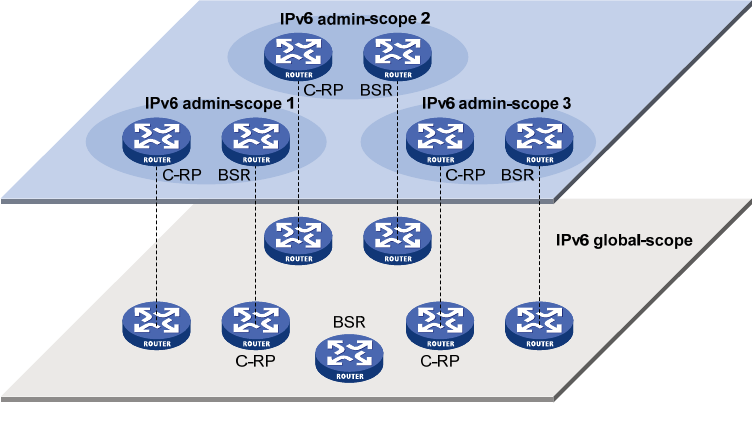
Relationship between IPv6 admin-scope zones and the IPv6 global scope zone
The IPv6 global-scoped zone and each IPv6 admin-scoped zone have their own C-RPs and BSRs. These
devices are effective only on their respective zones, and the BSR election and the RP election are
implemented independently. Each IPv6 admin-scoped zone has its own boundary. The IPv6 multicast
information within a zone cannot cross this boundary in either direction. You can have a better
understanding of the IPv6 global-scoped zone and IPv6 admin-scoped zones based on geographical
locations and the scope field values.
• In view of geographical locations
An IPv6 admin-scope zone is a logical zone for particular IPv6 multicast groups with the same
scope filed value. The IPv6 multicast packets for such IPv6 multicast groups are confined within the
local IPv6 admin-scope zone and cannot cross the boundary of the zone.
Figure 51 Relationship in view of geographical locations