
R21xx-HP FlexFabric 11900 IP Multicast Configuration Guide
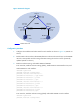
Table Of Contents
- Title Page
- Contents
- Multicast overview
- Configuring IGMP snooping
- Overview
- IGMP snooping configuration task list
- Configuring basic IGMP snooping functions
- Configuring IGMP snooping port functions
- Configuring IGMP snooping policies
- Displaying and maintaining IGMP snooping
- IGMP snooping configuration examples
- Troubleshooting IGMP snooping
- Configuring multicast routing and forwarding
- Configuring IGMP
- Configuring PIM
- Overview
- Configuring PIM-DM
- Configuring PIM-SM
- Configuring common PIM features
- Displaying and maintaining PIM
- PIM configuration examples
- Troubleshooting PIM
- Configuring MLD snooping
- Overview
- MLD snooping configuration task list
- Configuring basic MLD snooping functions
- Configuring MLD snooping port functions
- Configuring MLD snooping policies
- Displaying and maintaining MLD snooping
- MLD snooping configuration examples
- Troubleshooting MLD snooping
- Configuring IPv6 multicast routing and forwarding
- Configuring MLD
- Configuring IPv6 PIM
- PIM overview
- Configuring IPv6 PIM-DM
- Configuring IPv6 PIM-SM
- Configuring common IPv6 PIM features
- Displaying and maintaining IPv6 PIM
- IPv6 PIM configuration examples
- Troubleshooting IPv6 PIM
- Support and other resources
- Index
52
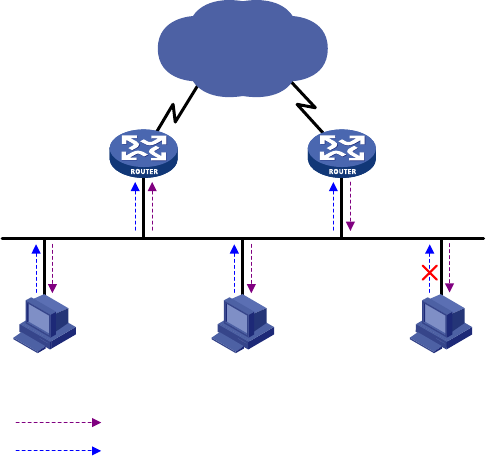
Figure 21 IGMP queries and reports
As shown in Figure 21, Host B and Host C are interested in the multicast data addressed to the multicast
group G1, and Host A is interested in the multicast data addressed to G2. The following process
describes how the hosts join the multicast groups and how the IGMP querier (Router B in Figure 21)
main
tains the multicast group memberships:
1. The hosts send unsolicited IGMP reports to the multicast groups they want to join without having to
wait for the IGMP queries from the IGMP querier.
2. The IGMP querier periodically multicasts IGMP queries (with the destination address of 224.0.0.1)
to all hosts and routers on the local subnet.
3. After receiving a query message, Host B or Host C (the host whose delay timer expires first) sends
an IGMP report to the multicast group G1 to announce its membership for G1. This example
assumes that Host B sends the report message. After receiving the report from Host B, Host C
suppresses its own report for G1 because the IGMP routers (Router A and Router B) already know
that G1 has at least one member host on the local subnet. This IGMP report suppression
mechanism helps reduce traffic on the local subnet.
4. At the same time, Host A sends a report to the multicast group G2 after receiving a query message.
5. Through the query and response process, the IGMP routers (Router A and Router B) determine that
the local subnet has members of G1 and G2, and the multicast routing protocol (PIM, for example)
on the routers generates (*, G1) and (*, G2) multicast forwarding entries, where asterisk (*)
represents any multicast source. These entries are the basis for subsequent multicast forwarding.
6. When the multicast data addressed to G1 or G2 reaches an IGMP router, the router looks up the
multicast forwarding table and forwards the multicast data to the local subnet based on the (*, G1)
or (*, G2) entry. Then, the receivers on the subnet can receive the data.
Query
Report
DR
Host A
(G2)
Host B
(G1)
Host C
(G1)
Ethernet
Router A Router B
IP network