
R21xx-HP FlexFabric 11900 IP Multicast Configuration Guide
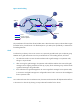
Table Of Contents
- Title Page
- Contents
- Multicast overview
- Configuring IGMP snooping
- Overview
- IGMP snooping configuration task list
- Configuring basic IGMP snooping functions
- Configuring IGMP snooping port functions
- Configuring IGMP snooping policies
- Displaying and maintaining IGMP snooping
- IGMP snooping configuration examples
- Troubleshooting IGMP snooping
- Configuring multicast routing and forwarding
- Configuring IGMP
- Configuring PIM
- Overview
- Configuring PIM-DM
- Configuring PIM-SM
- Configuring common PIM features
- Displaying and maintaining PIM
- PIM configuration examples
- Troubleshooting PIM
- Configuring MLD snooping
- Overview
- MLD snooping configuration task list
- Configuring basic MLD snooping functions
- Configuring MLD snooping port functions
- Configuring MLD snooping policies
- Displaying and maintaining MLD snooping
- MLD snooping configuration examples
- Troubleshooting MLD snooping
- Configuring IPv6 multicast routing and forwarding
- Configuring MLD
- Configuring IPv6 PIM
- PIM overview
- Configuring IPv6 PIM-DM
- Configuring IPv6 PIM-SM
- Configuring common IPv6 PIM features
- Displaying and maintaining IPv6 PIM
- IPv6 PIM configuration examples
- Troubleshooting IPv6 PIM
- Support and other resources
- Index
66
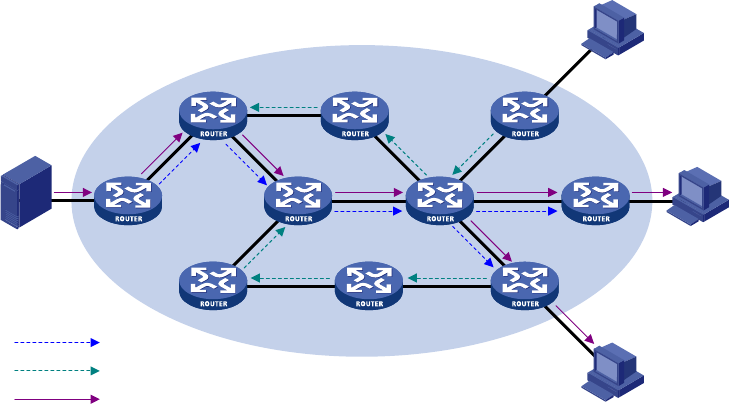
Figure 24 SPT building
The pruned state of a branch has a finite holdtime timer. When the timer expires, multicast data is again
forwarded to the pruned branch. The flood-and-prune cycle takes place periodically to maintain the
forwarding branches.
Graft
To reduce the join latency when a new receiver on a previously pruned branch joins a multicast group,
PIM-DM uses a graft mechanism to turn the pruned branch into a forwarding branch, as follows:
1. The node that needs to receive the multicast data sends a graft message to its upstream node,
telling it to rejoin the SPT.
2. After receiving this graft message, the upstream node adds the interface that received the graft
message into the outgoing interface list of the (S, G) entry for the multicast group, and then sends
a graft-ack message to the graft sender.
3. If the node that sent a graft message does not receive a graft-ack message from its upstream node,
it continues to send graft messages at a configurable interval until it receives an acknowledgment
from its upstream node.
Assert
On a subnet with more than one multicast router, the assert mechanism shuts off duplicate multicast flows
to the network. It does this by electing a unique multicast forwarder for the subnet.
Source
Server
Host A
Host B
Host C
Receiver
Receiver
Multicast packets
SPT
Prune message