
R21xx-HP FlexFabric 11900 IRF Configuration Guide

6
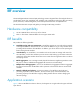
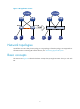
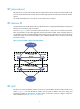
Figure 4 IRF split
IRF merge
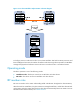
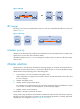
IRF merge occurs when two split IRF fabrics reunite or when two independent IRF fabrics are united, as
shown in Figure 5.
Figure 5 IRF merge
Member priority
Member priority determines the possibility of a member device to be elected the master. A member with
higher priority is more likely to be elected the master.
The default member priority is 1. You can change the member priority of a device to affect the master
election result.
Master election
Master election is held each time the IRF fabric topology changes, for example, when the IRF fabric is
established, the master device fails or is removed, the IRF fabric splits, or two active IRF fabrics merge.
Master election uses the following rules in descending order:
1. Current master, even if a new member has higher priority.
When an IRF fabric is being formed, all member devices consider themselves as the master, and
this rule is skipped.
2. Member with higher priority.
3. Member with the longest system uptime.
Two members are considered starting up at the same time if their startup time difference is equal
to or less than 10 minutes. For these members, the next tiebreaker applies.
4. Member with the lowest member ID.
The IRF fabric is formed on election of the master.
During an IRF merge, the devices of the IRF fabric that fails the master election must reboot to rejoin the
IRF fabric that wins the election. The reboot can be automatically performed or manually performed,
depending on the configuration. See "Enabling IRF auto merge."
IRF link
XGE1/3/0/1
XGE2/3/0/1
Device A Device B
Device A
Device B
IRF 1
IRF 2
IRF
+
=