
R21xx-HP FlexFabric 11900 IRF Configuration Guide

7
After a master election, all subordinate devices reboot with the configuration on the master. The
subordinate members' configuration files do not take effect in IRF mode. Their configuration files take
effect after their operating mode is converted to standalone.
IRF multi-active detection
An IRF link failure causes an IRF fabric to split in two IRF fabrics operating with the same Layer 3
configurations, including the same IP address. To avoid IP address collision and network problems, IRF
uses multi-active detection (MAD) mechanisms to detect the presence of multiple identical IRF fabrics,
handle collisions, and recover from faults.
Multi-active handling procedure
The multi-active handling procedure includes detection, collision handling and failure recovery.
Detection
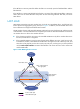
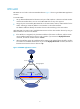
The MAD implementation of this device detects active IRF fabrics with the same Layer 3 global
configuration by extending the LACP or BFD protocol.
These MAD mechanisms identify each IRF fabric with a domain ID and an active ID (the member ID of
the master). If multiple active IDs are detected in a domain, MAD determines that an IRF collision or split
has occurred.
You can use at least one of these mechanisms in an IRF fabric, depending on your network topology.
IMPORTANT:
LACP MAD handles collisions in a different way than BFD MAD. To avoid conflicts, do not enable LACP
MAD with BFD MAD.
For a comparison of these MAD mechanisms, see "Configuring MAD."
Collision handling
MAD mechanisms remove multi-active collisions by setting one IRF fabric to the Active state and other IRF
fabrics to the Recovery state. Only members in the Active-state fabric can continue to forward traffic.
LACP MAD handles a multi-active collision in the following procedure:
1. Compares the number of members in each fabric.
2. Sets the fabric that has the most members to the Active state and all other fabrics to the Recovery
state.
3. If all IRF fabrics have the same number of members, compares the member IDs of their masters.
4. Sets the IRF fabric that has the lowest numbered master to the Active state and all other fabrics to
the Recovery (disabled) state.
5. Shuts down all physical network ports in the Recovery-state fabrics except their physical IRF ports
and any ports you have specified with the mad exclude interface command.
In contrast, BFD MAD does not compare the number of members in fabrics. It directly sets the IRF fabric
that has the lowest numbered master to the Active state, sets all other fabrics to the Recovery state, and
takes the same action on the network ports in Recovery-state fabrics as LACP MAD does.
Failure recovery
To merge two split IRF fabrics, first repair the failed IRF link and remove the IRF link failure.