
R21xx-HP FlexFabric 11900 Layer 2 LAN Switching Command Reference


33
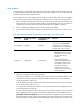
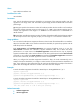
mdi: Specifies that pins 1 and 2 are transmit pins and pins 3 and 6 are receive pins.
mdix: Specifies that pins 1 and 2 are receive pins and pins 3 and 6 are transmit pins.
Examples
# Set Ten-GigabitEthernet 1/0/1 to operate in MDI mode.
<Sysname> system-view
[Sysname] interface ten-gigabitethernet 1/0/1
[Sysname-Ten-GigabitEthernet1/0/1] mdix-mode mdi
multicast-suppression
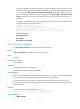
Use multicast-suppression to enable multicast storm suppression and set the multicast storm suppression
threshold.
Use undo multicast-suppression to restore the default.
Syntax
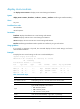
multicast-suppression { ratio | pps max-pps | kbps max-kbps }
undo multicast-suppression
Default
Ethernet interfaces do not suppress multicast traffic.
Views
Layer 2 Ethernet interface view
Predefined user roles
network-admin
Parameters
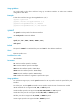
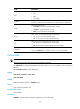
ratio: Sets the multicast suppression threshold as a percentage of the maximum interface rate. This
argument (in percentage) is in the range of 0 to 100. The smaller the percentage, the less multicast traffic
is allowed to pass through.
pps max-pps: Specifies the maximum number of multicast packets that the interface can forward per
second. The max-pps argument (in pps) is in the range of 1 to 1.4881 × the maximum interface rate. For
example, this argument is in the range of 1 to 1488100 on a GE interface and 1 to 59524000 on a
40-GE interface.
kbps max-kbps: Specifies the maximum number of kilobits of multicast traffic that the Ethernet interface
can forward per second. This argument (in kbps) is in the range of 1 to the maximum interface rate.
Usage guidelines
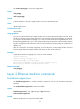
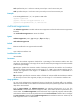
You can use the multicast storm suppression function to limit the size of multicast traffic on an interface.
When the multicast traffic on the interface exceeds this threshold, the system drops packets until the traffic
drops below this threshold.
Both the storm-constrain and multicast-suppression can suppress multicast storm on a port. The
storm-constrain command uses software to suppress traffic, and it affects the device performance to a
certain extent. The multicast-suppression command uses the chip to physically suppress multicast traffic,
and it has less influence on the device performance than the storm-constrain command. Do not configure
the storm constrain command and the multicast-suppression command at the same time. Otherwise, the
traffic suppression result is not determined.