
R21xx-HP FlexFabric 11900 Layer 2 LAN Switching Configuration Guide


114
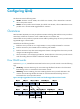
For correct transmission of tagged frames, HP recommends that you set the MTU of each interface on the
service provider network to at least 1504 bytes, which is the sum of the default interface MTU (1500 bytes)
and the size of a VLAN tag (4 bytes).
The devices in the service provider network forward a tagged frame according to its SVLAN tag only,
and they transmit the CVLAN tag as part of the frame's payload.
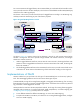
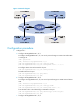
Figure 30 Typical QinQ application scenario
As shown in Figure 30, customer network A has CVLANs 1 through 10, and customer network B has
CVLANs 1 through 20. The service provider assigns SVLAN 3 to customer network A, and assigns
SVLAN 4 to customer network B.
1. When a tagged Ethernet frame from customer network A arrives at PE1, the PE tags the frame with
SVLAN 3. When a tagged Ethernet frame from customer network B arrives at PE2, the PE tags the
frame with SVLAN 4.
2. The double-tagged Ethernet frame is then transmitted over the service provider network and arrives
at the other PE. The PE removes the SVLAN tag of the frame before sending it to the target CE.
Implementations of QinQ
QinQ is enabled on a per-port basis. The link type of a QinQ-enabled port can be access, hybrid, or
trunk. The QinQ tagging behaviors are the same across these types of ports.
A QinQ-enabled port tags all incoming frames (tagged or untagged) with the PVID tag. If an incoming
frame already has one tag, it becomes a double-tagged frame. If the frame does not have any 802.1Q
tag, it becomes a frame tagged with the PVID.
QinQ provides the most basic VLAN manipulation method, which tags all incoming frames (tagged or
untagged) with the PVID tag. To perform advanced VLAN manipulations, use VLAN mapping (see
"Configuring VLAN mapping") or QoS poli
c
ies. For example:
• To use different SVLANs for different CVLAN tags, use one-to-two VLAN mapping.
• To replace the SVLAN ID, CVLAN ID, or both IDs for an incoming double-tagged frame, configure
two-to-two VLAN mapping.