
R21xx-HP FlexFabric 11900 Layer 2 LAN Switching Configuration Guide


11
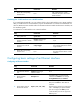
Step Command Remarks
3. Enable broadcast suppression
and set the broadcast
suppression threshold.
broadcast-suppression { ratio | pps
max-pps | kbps max-kbps }
By default, broadcast
traffic is allowed to pass
through an interface.
4. Enable multicast suppression
and set the multicast
suppression threshold.
multicast-suppression { ratio | pps max-pps
| kbps max-kbps }
By default, multicast traffic
is allowed to pass through
an interface.
5. Enable unknown unicast
suppression and set the
unknown unicast suppression
threshold.
unicast-suppression { ratio | pps max-pps |
kbps max-kbps }
By default, unknown
unicast traffic is allowed
to pass through an
interface.
Configuring storm control on an Ethernet interface
About storm control
Storm control compares broadcast, multicast, and unknown unicast traffic regularly with their respective
traffic thresholds on an Ethernet interface. For each type of traffic, storm control provides a lower
threshold and a higher threshold.
For management purposes, you can configure the interface to output threshold event traps and log
messages when monitored traffic exceeds the upper threshold or falls below the lower threshold from the
upper threshold.
Depending on your configuration, when a particular type of traffic exceeds its upper threshold, the
interface does either of the following:
• Blocks this type of traffic, while forwarding other types of traffic—Even though the interface does
not forward the blocked traffic, it still counts the traffic. When the blocked traffic drops below the
lower threshold, the port begins to forward the traffic.
• Shuts down automatically—The interface shuts down automatically and stops forwarding any
traffic. When the blocked traffic is detected dropping below the lower threshold, the port does not
forward the traffic. To bring up the interface, use the undo shutdown command or disable the storm
control function.
Any of the storm-constrain, broadcast-suppression, multicast-suppression, and unicast-suppression
commands can suppress storm on a port. The broadcast-suppression, multicast-suppression, and
unicast-suppression commands suppress traffic in hardware, and have less impact on device
performance than the storm-constrain command, which performs suppression in software.
Storm control uses a complete polling cycle to collect traffic data, and analyzes the data in the next cycle.
An interface takes one to two polling intervals to take a storm control action.
Configuration guidelines
For the same type of traffic, do not configure the storm constrain command together with any of the
broadcast-suppression, multicast-suppression, and unicast-suppression commands. Otherwise, the
traffic suppression result is not determined. For more information about the broadcast-suppression,
multicast-suppression, and unicast-suppression commands, see "Configuring storm suppression."
Configuration procedure
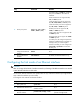
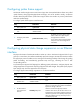
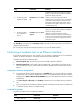
To configure storm control on an Ethernet interface: