
R21xx-HP FlexFabric 11900 Layer 3 IP Routing Configuration Guide

112
Configuring IS-IS
This chapter describes how to configure IS-IS for IPv4 networks.
Overview
Intermediate System-to-Intermediate System (IS-IS) is a dynamic routing protocol designed by the ISO to
operate on the connectionless network protocol (CLNP).
IS-IS was modified and extended in RFC 1195 by the IETF for application in both TCP/IP and OSI
reference models, called "Integrated IS-IS" or "Dual IS-IS."
IS-IS is an IGP used within an AS. It uses the SPF algorithm for route calculation.
Terminology
• Intermediate system—Similar to a router in TCP/IP, IS is the basic unit used in an IS-IS routing
domain to generate and propagate routing information. Throughout this chapter, an IS refers to a
router.
• End system—Similar to a host in TCP/IP, an ES does not run IS-IS. ISO defines the ES-IS protocol for
communication between an ES and an IS.
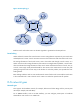
• Routing domain—An RD comprises a group of ISs that exchange routing information with each
other by using the same routing protocol.
• Area—An IS-IS routing domain can be split into multiple areas.
• Link State Database—All link states in the network form the LSDB. Each IS has at least one LSDB. An
IS uses the SPF algorithm and LSDB to generate IS-IS routes.
• Link State Protocol Data Unit or Link State Packet —An IS advertises link state information in an LSP.
• Network Protocol Data Unit—An NPDU is a network layer protocol packet in OSI, similar to an IP
packet in TCP/IP.
• Designated IS—A DIS is elected on a broadcast network.
• Network service access point—An NSAP is an OSI network layer address. The NSAP identifies an
abstract network service access point and describes the network address format in the OSI
reference model.