
R21xx-HP FlexFabric 11900 Layer 3 IP Routing Configuration Guide

113
IS-IS address format
NSAP
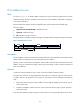
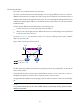
As shown in Figure 30, an NSAP address comprises the Initial Domain Part (IDP) and the Domain
Specific Part (DSP). The IDP is analogous to the network ID of an IP address, and the DSP is analogous
to the subnet and host ID.
The IDP includes the Authority and Format Identifier (AFI) and the Initial Domain Identifier (IDI).
The DSP includes:
• High Order Part of DSP (HO-DSP)—Identifies the area.
• System ID—Identifies the host.
• SEL—Identifies the type of service.
The IDP and DSP are variable in length. The length of an NSAP address ranges from 8 bytes to 20 bytes.
Figure 30 NSAP address format
Area address
The area address comprises the IDP and the HO-DSP of the DSP, which identify the area and the routing
domain. Different routing domains cannot have the same area address.
Typically, a router only needs one area address, and all nodes in the same area must have the same area
address. To support smooth area merging, partitioning, and switching, a router can have a maximum of
three area addresses.
System ID
A system ID uniquely identifies a host or router. It has a fixed length of 48 bits (6 bytes).
The system ID of a device can be generated from the router ID. For example, suppose a router uses the
IP address 168.10.1.1 of Loopback 0 as the router ID. The system ID can be obtained in the following
steps:
1. Extend each decimal number of the IP address to three digits by adding 0s from the left, such as
168.010.001.001.
2. Divide the extended IP address into three sections that each has four digits to get the system ID
1680.1000.1001.
If you use other methods to define a system ID, make sure that it can uniquely identify the host or router.