
R21xx-HP FlexFabric 11900 Layer 3 IP Routing Configuration Guide
114
SEL
The N-SEL, or the NSAP selector (SEL), is similar to the protocol identifier in IP. Different transport layer
protocols correspond to different SELs. All SELs in IP are 00.
Routing method
The IS-IS address format identifies the area, so a Level-1 router can easily identify packets destined to
other areas. IS-IS routers perform routing as follows:
• A Level-1 router performs intra-area routing according to the system ID. If the destination address of
a packet does not belong to the local area, the Level-1 router forwards it to the nearest Level-1-2
router.
• A Level-2 router performs inter-area routing according to the area address.
NET
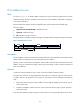
A network entity title (NET) identifies the network layer information of an IS. It does not include transport
layer information. A NET is a special NSAP address with the SEL being 0. The length of a NET ranges
from 8 bytes to 20 bytes, same as a NSAP address.
A NET includes the following parts:
• Area ID—Has a length of 1 to 13 bytes.
• System ID—A system ID uniquely identifies a host or router in the area and has a fixed length of 6
bytes.
• SEL—Has a value of 0 and a fixed length of 1 byte.
For example, for a NET ab.cdef.1234.5678.9abc.00, the area ID is ab.cdef, the system ID is
1234.5678.9abc, and the SEL is 00.
Typically, a router only needs one NET, but it can have a maximum of three NETs for smooth area
merging and partitioning. When you configure multiple NETs, make sure the system IDs are the same.
IS-IS area
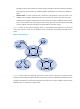
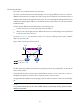
IS-IS has a 2-level hierarchy to support large-scale networks. A large-scale routing domain is divided into
multiple areas. Typically, a Level-1 router is deployed within an area, a Level-2 router is deployed
between areas, and a Level-1-2 router is deployed between Level-1 and Level-2 routers.
Level-1 and Level-2
• Level-1 router—A Level-1 router establishes neighbor relationships with Level-1 and Level-1-2 routers
in the same area. It maintains an LSDB comprising intra-area routing information. A Level-1 router
forwards packets destined for external areas to the nearest Level-1-2 router. Level-1 routers in different
areas cannot establish neighbor relationships.
• Level-2 router—A Level-2 router establishes neighbor relationships with Level-2 and Level-1-2 routers
in the same area or in different areas. It maintains a Level-2 LSDB containing inter-area routing