
R21xx-HP FlexFabric 11900 Layer 3 IP Routing Configuration Guide

116
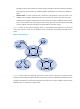
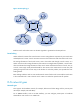
Figure 32 IS-IS topology 2
Both the Level-1 and Level-2 routers use the SPF algorithm to generate the shortest path tree.
Route leaking
Level-2 and Level-1-2 routers form a Level-2 area. An IS-IS routing domain comprises only one Level-2 area
and multiple Level-1 areas. A Level-1 area must connect to the Level-2 area rather than other Level-1 area.
The routing information of each Level-1 area is sent to the Level-2 area through a Level-1-2 router, so a
Level-2 router knows the routing information of the entire IS-IS routing domain. By default, a Level-2 router
does not advertise the routing information of other Level-1 areas and the Level-2 area to a Level-1 area, so
a Level-1 router simply sends packets destined for other areas to the nearest Level-1-2 router. The path
passing through the Level-1-2 router may not be the best. To solve this problem, IS-IS provides the route
leaking feature.
Route leaking enables a Level-1-2 router to advertise the routes of other Level-1 areas and the Level-2 area
to the connected Level-1 area so that the Level-1 routers can select the optimal routes for packets.
IS-IS network types
Network types
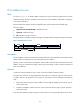
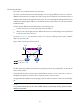
IS-IS supports the broadcast network (for example, Ethernet and Token Ring) and the point-to-point
network (for example, PPP and HDLC).
For an NBMA interface, such as an ATM interface, you must configure point-to-point or broadcast
subinterfaces. IS-IS cannot run on P2MP links.
Area 1
Area 3
Area 5
Area 4
Area 2
L1
L1/L2
L2
L2
L2
L1
L1/L2
L1/L2
L2
L1 L1
L1/L2
L1
L1