
R21xx-HP FlexFabric 11900 Layer 3 IP Routing Configuration Guide

117
DIS and pseudonodes
IS-IS routers on a broadcast network must elect a DIS.
The Level-1 and Level-2 DISs are elected separately. You can assign different priorities to a router for
different level DIS elections. The higher the router priority, the more likely the router becomes the DIS. If
multiple routers with the same highest DIS priority exist, the one with the highest SNPA (Subnetwork Point
of Attachment) address (MAC address on a broadcast network) will be elected. A router can be the DIS
for different levels.
IS-IS DIS election differs from OSPF DIS election in the following ways:
• A router with priority 0 can also participate in the DIS election.
• When a router with a higher priority is added to the network, an LSP flooding process is performed
to elect the router as the new DIS.
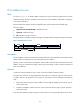
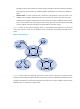
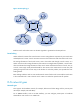
As shown in Figure 33, the same l
evel routers on a network, including non-DIS routers, establish
adjacency with each other.
Figure 33 DIS in the IS-IS broadcast network
The DIS creates and updates pseudonodes, and generates LSPs for the pseudonodes, to describe all
routers on the network.
A pseudonode represents a virtual node on the broadcast network. It is not a real router. In IS-IS, it is
identified by the system ID of the DIS and a 1-byte Circuit ID (a non-zero value).
Using pseudonodes simplifies network topology and can reduce the amount of resources consumed by
SPF.
NOTE:
On an IS-IS broadcast network, all routers establish adjacency relationships, but they synchronize their
LSDBs through the DIS.
L1
L2
L1/L2 L1/L2
DIS DIS
L1 adjacencies
L2 adjacencies