
R21xx-HP FlexFabric 11900 Layer 3 IP Routing Configuration Guide




170
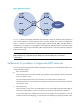
Figure 48 Network diagram
In Figure 48, Router A and Router B are IBGP peers of Router C. Router D and Router E both advertise a
route 9.0.0.0 to Router C. If load balancing with a maximum number of two routes is configured on
Router C, and the two routes have the same AS_PATH, ORIGIN, LOCAL_PREF, and MED, Router C
installs both the two routes to its routing table for load balancing. After that, Router C forwards to Router
A and Router B a single route that has NEXT_HOP changed to Router C and other attributes changed to
those of the best route.
NOTE:
BGP load balancing is applicable between EBGP peers, between IBGP peers, and between
confederations.
Settlements for problems in large-scale BGP networks
You can use the following methods to facilitate management and improve route distribution efficiency on
a large-scale BGP network.
• Route summarization
Route summarization can reduce the BGP routing table size by advertising summary routes rather
than more specific routes.
The system supports both manual and automatic route summarization. Manual route
summarization allows you to determine the attribute of a summary route and whether to advertise
more specific routes.
• Route dampening
Route frapping (a route comes up and disappears in the routing table frequently) causes BGP to
send many routing updates. It can consume too many resources and affect other operations.
In most cases, BGP runs in complex networks where route changes are more frequent. To solve the
problem caused by route flapping, you can use BGP route dampening to suppress unstable routes.