
R21xx-HP FlexFabric 11900 Layer 3 IP Routing Configuration Guide

279
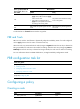
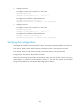
Ste
p
Command
Remarks
2. Create a node for a policy, and
enter policy node view.
policy-based-route policy-name
[ deny | permit ] node node-number
By default, no policy node is
created.
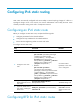
Configuring match criteria for a node
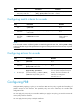
Ste
p
Command Remarks
1. Enter system
view.
system-view N/A
2. Enter policy
node view.
policy-based-route policy-name [ deny | permit ] node
node-number
N/A
3. Configure an
ACL match
criterion.
if-match acl acl-number
By default, no ACL
match criterion is
configured.
NOTE:
If an ACL match criterion is defined, packets are matched against the ACL rules, and the permit or den
y
action and the time ran
g
e of the specified ACL are i
g
nored. If the specified ACL does not exist, no packe
t
is matched.
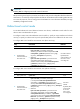
Configuring actions for a node
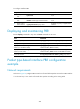
Ste
p
Command Remarks
1. Enter system
view.
system-view N/A
2. Enter policy
node view.
policy-based-route policy-name [ deny |
permit ] node node-number
N/A
3. Set next hops.
apply next-hop [ vpn-instance
vpn-instance-name ] { ip-address [ direct ]
[ track track-entry-number ] }&<1-n>
By default, no next hop is specified.
You can specify multiple next hops for
backup, which are executed in the
order they are configured.
The value of n is 2.
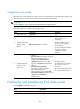
Configuring PBR
Configure PBR by applying a policy to an interface. PBR uses the policy to guide the forwarding of
packets received on the interface. The specified policy must exist. Otherwise, the interface PBR
configuration fails.
You can apply only one policy to an interface. Before you apply a new policy, you must first remove the
current policy from the interface.
You can apply the same policy to multiple interfaces.