
R21xx-HP FlexFabric 11900 Layer 3 IP Routing Configuration Guide

317
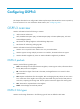
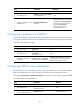
Ste
p
Command
Remarks
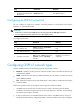
4. Configure OSPFv3 to
redistribute routes from other
routing protocols.
import-route protocol [ process-id |
all-processes | allow-ibgp ] [ cost cost |
route-policy route-policy-name | type
type ] *
By default, route redistribution
is disabled.
5. (Optional.) Configure
OSPFv3 to redistribute a
default route.
default-route-advertise [ [ always |
permit-calculate-other ] | cost cost |
route-policy route-policy-name | type
type ] *
By default, no default route is
redistributed.
This command can only inject
and advertise a default route.
6. (Optional.) Configure
OSPFv3 to filter redistributed
routes.
filter-policy { acl6-number | prefix-list
prefix-list-name } export [ protocol
[ process-id ] ]
By default, OSPFv3 accepts
all redistributed routes.
This command filters only
routes redistributed with the
import-route command. If the
import-route command is not
configured, executing this
command does not take
effect.
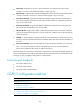
Tuning and optimizing OSPFv3 networks
This section describes configurations of OSPFv3 timers, interface DR priority, and the logging of
neighbor state changes.
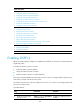
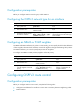
Configuration prerequisites
Before you tune and optimize OSPFv3 networks, complete the following tasks:
• Configure IPv6 addresses for interfaces to ensure IPv6 connectivity between neighboring nodes.
• Enable OSPFv3.
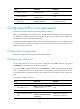
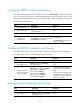
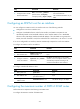
Configuring OSPFv3 timers
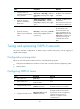
Ste
p
Command
Remarks
1. Enter system view. system-view N/A
2. Enter interface view.
interface interface-type
interface-number
N/A
3. Configure the hello interval.
ospfv3 timer hello seconds
[ instance instance-id ]
By default, the hello interval on P2P and
broadcast interfaces is 10 seconds.
4. Configure the dead interval.
ospfv3 timer dead seconds
[ instance instance-id ]
By default, the dead interval on P2P and
broadcast interfaces is 40 seconds.
The dead interval set on neighboring
interfaces cannot be too short.
Otherwise, a neighbor is easily
considered down.