
R21xx-HP FlexFabric 11900 Layer 3 IP Routing Configuration Guide


54
Route types
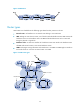
OSPF prioritizes routes into the following route levels:
• Intra-area route
• Inter-area route
• Type-1 external route
• Type-2 external route
The intra-area and inter-area routes describe the network topology of the AS. The external routes describe
routes to external ASs.
A Type-1 external route has high credibility. The cost from a router to the destination of a Type-1 external
route = the cost from the router to the corresponding ASBR + the cost from the ASBR to the destination of
the external route.
A Type-2 external route has low credibility. OSPF considers the cost from the ASBR to the destination of
a Type-2 external route is much greater than the cost from the ASBR to an OSPF internal router. The cost
from the internal router to the destination of the Type-2 external route = the cost from the ASBR to the
destination of the Type-2 external route. If two Type-2 routes to the same destination have the same cost,
OSPF takes the cost from the router to the ASBR into consideration to determine the best route.
Route calculation
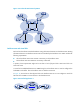
OSPF computes routes in an area as follows:
• Each router generates LSAs based on the network topology around itself, and sends them to other
routers in update packets.
• Each OSPF router collects LSAs from other routers to compose an LSDB. An LSA describes the
network topology around a router, and the LSDB describes the entire network topology of the area.
• Each router transforms the LSDB to a weighted directed graph that shows the topology of the area.
All the routers within the area have the same graph.
• Each router uses the SPF algorithm to compute a shortest path tree that shows the routes to the nodes
in the area. The router itself is the root of the tree.
OSPF network types
OSPF classifies networks into the following types, depending on different link layer protocols:
• Broadcast—If the link layer protocol is Ethernet or FDDI, OSPF considers the network type as
broadcast by default. On a broadcast network, hello, LSU, and LSAck packets are multicast to
224.0.0.5 that identifies all OSPF routers or to 224.0.0.6 that identifies the DR; DD packets and LSR
packets are unicast.
• NBMA—If the link layer protocol is Frame Relay, ATM, or X.25, OSPF considers the network type
as NBMA by default. OSPF packets are unicast on a NBMA network.