
R21xx-HP FlexFabric 11900 Layer 3 IP Services Command Reference




164
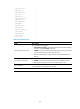
Field Descri
p
tion
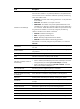
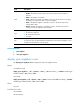
Global unicast address(es)
Global unicast addresses of the interface:
If the state of an address is not preferred (addresses in the preferred state
can be used as source or destination addresses of packets), the following
marks other address states:
• TENTATIVE—Initial state. DAD is being performed or is to be performed
on the address.
• DUPLICATE—The address is not unique on the link.
• DEPRECATED—The address is beyond the preferred lifetime but in the
valid lifetime. It is valid, but it cannot be used as the source address for a
new connection. Packets destined to the address are processed normally.
If a global unicast address is not manually configured, the following
notations indicate how the address is obtained:
• AUTOCFG—Stateless autoconfigured.
• DHCP—Assigned by a DHCPv6 server.
• EUI-64—Manually configured EUI-64 IPv6 address.
• RANDOM—Random address automatically generated.
If the address is a manually configured anycast address, it is noted with
ANYCAST.
valid lifetime
Specifies how long autoconfigured global unicast addresses using a prefix
are valid.
preferred lifetime
Specifies how long autoconfigured global unicast addresses using a prefix
are preferred.
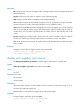
Joined group address(es) Addresses of multicast groups that the interface has joined.
MTU Maximum transmission unit (MTU) of the interface.
ND DAD is enabled, number of
DAD attempts
DAD is enabled.
• If DAD is enabled, this field displays the number of attempts to send a NS
message for DAD (set with the ipv6 nd dad attempts command).
• If DAD is disabled, this field displays ND DAD is disabled. To disable
DAD, set the number of attempts to 0.
ND reachable time Time during which a neighboring device is reachable.
ND retransmit interval Interval for retransmitting an NS message.
Hosts use stateless autoconfig
for addresses
Hosts obtained IPv6 addresses through stateless autoconfiguration.
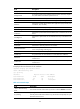
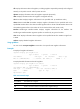
InReceives All IPv6 packets received by the interface, including error packets.
InTooShorts
Received IPv6 packets that are too short, with a length less than 40 bytes, for
example.
InTruncatedPkts Received IPv6 packets with a length less than that specified in the packets.
InHopLimitExceeds Received IPv6 packets with a hop count exceeding the limit.
InBadHeaders Received IPv6 packets with incorrect basic headers.
InBadOptions Received IPv6 packets with incorrect extension headers.
ReasmReqds Received IPv6 fragments.
ReasmOKs Number of reassembled packets rather than the number of fragments.