
R21xx-HP FlexFabric 11900 Layer 3 IP Services Configuration Guide




96
56 bytes from 1::2, icmp_seq=0 hlim=128 time=1.000 ms
56 bytes from 1::2, icmp_seq=1 hlim=128 time=0.000 ms
56 bytes from 1::2, icmp_seq=2 hlim=128 time=1.000 ms
56 bytes from 1::2, icmp_seq=3 hlim=128 time=1.000 ms
56 bytes from 1::2, icmp_seq=4 hlim=128 time=0.000 ms
--- host.com ping6 statistics ---
5 packet(s) transmitted, 5 packet(s) received, 0.0% packet loss
round-trip min/avg/max/std-dev = 0.000/0.600/1.000/0.490 ms
Dynamic domain name resolution configuration example
Network requirements
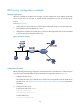
As shown in Figure 41, the device wants to access the host by using an easy-to-remember domain name
rather than an IPv6 address. The IPv6 address of the DNS server is 2::2/64, and the server has a com
domain, which stores the mapping between domain name host and IPv6 address 1::1/64.
Configure dynamic domain name resolution and the domain name suffix com on the device that serves
as a DNS client so that the device can use domain name host to access the host with the domain name
host.com and the IPv6 address 1::1/64.
Figure 41 Network diagram
Configuration procedure
Before performing the following configuration, make sure the device and the host can reach each other,
and the IPv6 addresses of the interfaces are configured, as shown Figure 41.
T
his configuration may vary with DNS servers. The following configuration is performed on a PC running
Windows Server 2003. Make sure that the DNS server supports the IPv6 DNS function so that the server
can process IPv6 DNS packets, and the interfaces of the DNS server can forward IPv6 packets.
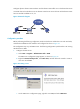
1. Configure the DNS server:
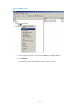
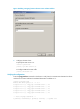
a. Select Start > Programs > Administrative Tools > DNS.
The DNS server configuration page appears, as shown in Figure 42.
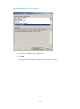
b. Right click Forward Lookup Zones, select New Zone, and then follow the wizard to create a
new zone named com.