
R21xx-HP FlexFabric 11900 Layer 3 IP Services Configuration Guide


127
Unicast addresses
Unicast addresses comprise global unicast addresses, link-local unicast addresses, the loopback address,
and the unspecified address.
• Global unicast addresses—Equivalent to public IPv4 addresses, are provided for Internet service
providers. This type of address allows for prefix aggregation to restrict the number of global routing
entries.
• Link-local addresses—Used for communication among link-local nodes for neighbor discovery and
stateless autoconfiguration. Packets with link-local source or destination addresses are not
forwarded to other links.
• A loopback address—0:0:0:0:0:0:0:1 (or ::1). It has the same function as the loopback address in
IPv4. It cannot be assigned to any physical interface. A node uses this address to send an IPv6
packet to itself.
• An unspecified address—0:0:0:0:0:0:0:0 (or ::). It cannot be assigned to any node. Before
acquiring a valid IPv6 address, a node fills this address in the source address field of IPv6 packets.
The unspecified address cannot be used as a destination IPv6 address.
Multicast addresses
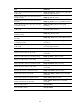
IPv6 multicast addresses listed in Table 7 are reserved for special purposes.
Table 7 Reserved IPv6 multicast addresses
Address Application
FF01::1 Node-local scope all-nodes multicast address.
FF02::1 Link-local scope all-nodes multicast address.
FF01::2 Node-local scope all-routers multicast address.
FF02::2 Link-local scope all-routers multicast address.
Multicast addresses also include solicited-node addresses. A node uses a solicited-node multicast
address to acquire the link-layer address of a neighboring node on the same link and to detect duplicate
addresses. Each IPv6 unicast or anycast address has a corresponding solicited-node address. The format
of a solicited-node multicast address is FF02:0:0:0:0:1:FFXX:XXXX. FF02:0:0:0:0:1:FF is fixed and
consists of 104 bits, and XX:XXXX is the last 24 bits of an IPv6 unicast address or anycast address.
EUI-64 address-based interface identifiers
An interface identifier is 64-bit long and uniquely identifies an interface on a link. Interfaces generate
EUI-64 address-based interface identifiers differently.
• On an IEEE 802 interface (such as an Ethernet interface and a VLAN interface)—The interface
identifier is derived from the link-layer address (typically a MAC address) of the interface. The MAC
address is 48-bit long. To obtain an EUI-64 address-based interface identifier, insert the
hexadecimal number FFFE (16 bits of 1111111111111110) into the MAC address (behind the 24th
high-order bit), and set the universal/local (U/L) bit (which is the seventh high-order bit) to 1,
ensuring that the obtained interface identifier is globally unique.