
R21xx-HP FlexFabric 11900 Layer 3 IP Services Configuration Guide




130
1.
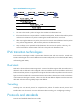
Host A sends an NS message whose source address is the unspecified address and whose
destination address is the corresponding solicited-node multicast address of the IPv6 address to be
detected. The NS message body contains the detected IPv6 address.
2. If Host B uses this IPv6 address, Host B returns an NA message that contains its IPv6 address.
3. Host A knows that the IPv6 address is being used by Host B after receiving the NA message from
Host B. If receiving no NA message, Host A decides that the IPv6 address is not in use and uses this
address.
Router/prefix discovery and stateless address autoconfiguration
A node performs router/prefix discovery and stateless address autoconfiguration as follows:
1. At startup, a node sends an RS message to request configuration information from a router.
2. The router returns an RA message containing the Prefix Information option and other configuration
information. (The router also periodically sends an RA message.)
3. The node automatically generates an IPv6 address and other configuration parameters according
to the configuration information in the RA message.
The Prefix Information option contains an address prefix and the preferred lifetime and valid lifetime of
the address prefix. A node updates the preferred lifetime and valid lifetime upon receiving a periodic RA
message.
The generated IPv6 address is valid within the valid lifetime and becomes invalid when the valid lifetime
expires.
After the preferred lifetime expires, the node cannot use the generated IPv6 address to establish new
connections, but can receive packets destined for the IPv6 address. The preferred lifetime cannot be
greater than the valid lifetime.
Redirection
Upon receiving a packet from a host, the gateway sends an ICMPv6 Redirect message to inform a better
next hop to the host when the following conditions are met (similar to the ICMP redirection function in
IPv4):
• The interface receiving the packet is the same as the interface forwarding the packet.
• The selected route is not created or modified by an ICMPv6 Redirect message.
• The selected route is not a default route on the device.
• The forwarded IPv6 packet does not contain the routing extension header.
IPv6 path MTU discovery
The links that a packet passes from a source to a destination can have different MTUs, among which the
minimum MTU is the path MTU. If a packet exceeds path MTU, the source end fragments the packet to
reduce the processing pressure on intermediate devices and to use network resources effectively.
A source end uses path MTU discovery to find the path MTU to a destination, as shown in Figure 56.