
R21xx-HP FlexFabric 11900 Layer 3 IP Services Configuration Guide





131
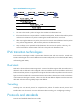
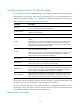
Figure 56 Path MTU discovery process
1. The source host sends a packet no larger than its MTU to the destination host.
2. If the MTU of a device's output interface is smaller than the packet, the device discards the packet
and returns an ICMPv6 error packet containing the interface MTU to the source host.
3. After receiving the ICMPv6 error packet, the source host uses the returned MTU to limit the packet
size, performs fragmentation, and sends the packets to the destination host.
4. Step 2 and step 3 are repeated until the destination host receives the packet. In this way, the
source host finds the minimum MTU of all links in the path to the destination host.
IPv6 transition technologies
IPv6 transition technologies enable communication between IPv4 and IPv6 networks. Several IPv6
transition technologies can be used in different environments and periods, such as dual stack (RFC 2893)
and tunneling (RFC 2893).
Dual stack
Dual stack is the most direct transition approach. A network node that supports both IPv4 and IPv6 is a
dual-stack node. A dual-stack node configured with an IPv4 address and an IPv6 address can forward
both IPv4 and IPv6 packets. An application that supports both IPv4 and IPv6 prefers IPv6 at the network
layer. Dual stack is suitable for communication between IPv4 nodes or between IPv6 nodes. It is the basis
of all transition technologies. However, it does not solve the IPv4 address depletion issue because each
dual stack node must have a globally unique IPv4 address.
Tunneling
Tunneling uses one network protocol to encapsulate the packets of another network protocol and
transfers them over the network. For more information about tunneling, see "Configuring tunneling.."
Protocols and standards
Protocols and standards related to IPv6 include: