
R21xx-HP FlexFabric 11900 Layer 3 IP Services Configuration Guide





172
Configuring tunneling
Overview
Tunneling is an encapsulation technology. One network protocol encapsulates packets of another
network protocol and transfers them over a virtual point-to-point connection. The virtual connection is
called a tunnel. Packets are encapsulated at the tunnel source end and de-encapsulated at the tunnel
destination end. Tunneling refers to the whole process from data encapsulation to data transfer to data
de-encapsulation.
Tunneling supports the following technologies:
• Transition techniques, such as IPv6 over IPv4 tunneling, to interconnect IPv4 and IPv6 networks.
• VPN, such as IPv4 over IPv4 tunneling, IPv4/IPv6 over IPv6 tunneling, GRE, DVPN, and IPsec
tunneling.
• Traffic engineering, such as MPLS TE to prevent network congestion.
Unless otherwise specified, the term tunnel in this document refers to IPv6 over IPv4, IPv4 over IPv4, IPv4
over IPv6, and IPv6 over IPv6 tunnels.
IPv6 over IPv4 tunneling
Implementation
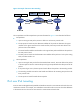
IPv6 over IPv4 tunneling adds an IPv4 header to IPv6 packets so that IPv6 packets can pass an IPv4
network through a tunnel to realize interworking between isolated IPv6 networks, as shown in Figure 71.
T
he devices at the ends of an IPv6 over IPv4 tunnel must support the IPv4/IPv6 dual stack.
Figure 71 IPv6 over IPv4 tunnel
The IPv6 over IPv4 tunnel processes packets in the following steps: