
R21xx-HP FlexFabric 11900 Layer 3 IP Services Configuration Guide




182
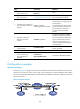
[SwitchB] interface Ten-GigabitEthernet 1/0/3
[SwitchB-Ten-GigabitEthernet1/0/3] port service-loopback group 1
[SwitchB-Ten-GigabitEthernet1/0/3] quit
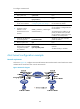
# Configure an IPv6 over IPv4 manual tunnel interface tunnel 0.
[SwitchB] interface tunnel 0 mode ipv6-ipv4
# Specify VLAN-interface 100 as the source interface for the tunnel interface.
[SwitchB-Tunnel0] source vlan-interface 100
# Specify the IP address of VLAN-interface 100 on Switch A as the destination address for the
tunnel interface.
[SwitchB-Tunnel0] destination 192.168.100.1
[SwitchB-Tunnel0] quit
# Configure a static route destined for IPv6 network 1 through tunnel 0 on Switch B.
[SwitchB] ipv6 route-static 3002:: 64 tunnel 0
Verifying the configuration
# Use the display ipv6 interface command to view tunnel interface status on Switch A and Switch B. The
output shows that the interface tunnel 0 is up. (Details not shown.)
# Switch B and Switch A can ping the IPv6 address of VLAN-interface 101 of each other. For example,
ping the IPv6 address of VLAN-interface 101 of Switch B from Switch A.
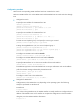
[SwitchA] ping ipv6 3003::1
PING6(104=40+8+56 bytes) 3001::1 --> 3003::1
56 bytes from 3003::1, icmp_seq=0 hlim=64 time=45.000 ms
56 bytes from 3003::1, icmp_seq=1 hlim=64 time=10.000 ms
56 bytes from 3003::1, icmp_seq=2 hlim=64 time=4.000 ms
56 bytes from 3003::1, icmp_seq=3 hlim=64 time=10.000 ms
56 bytes from 3003::1, icmp_seq=4 hlim=64 time=11.000 ms
--- 3003::1 ping6 statistics ---
5 packet(s) transmitted, 5 packet(s) received, 0.0% packet loss
round-trip min/avg/max/std-dev = 4.000/16.000/45.000/14.711 ms
Configuring a 6to4 tunnel
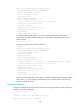
Follow these guidelines when you configure a 6to4 tunnel:
• You do not need to configure a destination address for a 6to4 tunnel, because the destination IPv4
address is embedded in the 6to4 IPv6 address.
• Because automatic tunnels do not support dynamic routing, you must configure a static route
destined for the destination IPv6 network if the destination IPv6 network is not in the same subnet
as the IPv6 address of the tunnel interface. You can specify the local tunnel interface as the egress
interface of the route or specify the IPv6 address of the peer tunnel interface as the next hop of the
route. For the detailed configuration, see Layer 3—IP Routing Configuration Guide.
• The automatic tunnel interfaces using the same encapsulation protocol cannot use the same source
IP address.