
R21xx-HP FlexFabric 11900 Layer 3 IP Services Configuration Guide



20
Configuring IP addressing
The IP addresses in this chapter refer to IPv4 addresses unless otherwise specified.
This chapter describes IP addressing basic and manual IP address assignment for interfaces. Dynamic IP
address assignment (BOOTP and DHCP) is beyond the scope of this chapter.
Overview
This section describes the IP addressing basics.
IP addressing uses a 32-bit address to identify each host on an IPv4 network. To make addresses easier
to read, they are written in dotted decimal notation, each address being four octets in length. For
example, address 00001010000000010000000100000001 in binary is written as 10.1.1.1.
IP address classes
Each IP address breaks down into the following sections:
• Net ID—Identifies a network. The first several bits of a net ID, known as the class field or class bits,
identify the class of the IP address.
• Host ID—Identifies a host on a network.
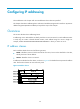
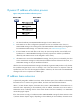
IP addresses are divided into five classes, as shown in Figure 8.
The shaded areas represent the address
class. The first three classes are most commonly used.
Figure 8 IP address classes