
R21xx-HP FlexFabric 11900 MPLS Configuration Guide
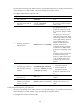


110
Ste
p
Command
Remarks
1. Enter system view. system-view N/A
2. Create an IS-IS process for a
VPN instance and enter IS-IS
view.
isis [ process-id ] vpn-instance
vpn-instance-name
Perform this configuration on the
PE. On the CE, configure common
IS-IS.
3. Configure a network entity
title for the IS-IS process.
network-entity net By default, no NET is configured.
4. Return to system view.
quit N/A
5. Enter interface view.
interface interface-type
interface-number
N/A
6. Enable the IS-IS process on
the interface.
isis enable [ process-id ]
By default, no IS-IS process is
enabled on the interface.
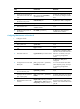
Configuring EBGP between a PE and a CE
1. Configure the PE:
Ste
p
Command
Remarks
1. Enter system view.
system-view N/A
2. Enable BGP and enter BGP
view.
bgp as-number N/A
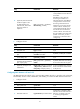
3. Enter BGP VPN view. ip vpn-instance vpn-instance-name
Configuration commands in BGP
VPN view are the same as those in
BGP view. For details, see Layer
3—IP Routing Configuration
Guide.
4. Configure the CE as the VPN
EBGP peer.
peer { group-name | ip-address }
as-number as-number
By default, no BGP peer is
configured.
For more information about BGP
peers and peer groups, see Layer
3—IP Routing Configuration
Guide.
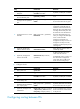
5. Create and enter BGP VPN
IPv4 unicast family view.
ipv4-family [ unicast ] N/A
6. Enable IPv4 unicast route
exchange with the specified
peer or peer group.
peer { group-name | ip-address }
enable
By default, BGP does not exchange
IPv4 unicast routes with any peer.
7. Redistribute the routes of the
local CE.
import-route protocol [ { process-id
| all-processes } [ med med-value |
route-policy route-policy-name ] * ]
A PE must redistribute the routes of
the local CE into its VPN routing
table so it can advertise them to the
peer PE.