
R21xx-HP FlexFabric 11900 MPLS Configuration Guide







115
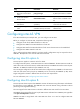
Ste
p
Command
Remarks
20. Enable route target-based
filtering of received VPNv4
routes.
policy vpn-target By default, this feature is enabled.
21. Enable route reflection
between clients.
reflect between-clients
By default, route reflection
between clients is enabled on the
RR.
22. Configure a cluster ID for the
route reflector.
reflector cluster-id { cluster-id |
ip-address }
By default, the RR uses its own
router ID as the cluster ID.
23. Configure filtering of reflected
routes.
rr-filter
extended-community-list-number
By default, the RR does not filter
reflected routes.
Configuring inter-AS VPN
If the MPLS backbone spans multiple ASs, you must configure inter-AS VPN.
Before you configure an inter-AS VPN, complete the following tasks:
• Configure an IGP for the MPLS backbones in each AS.
• Configure basic MPLS for the MPLS backbone of each AS.
• Configure MPLS LDP for the MPLS backbone of each AS so that LDP LSPs can be established.
• Configure basic MPLS L3VPN for each AS.
When configuring basic MPLS L3VPN for each AS, specific configurations may be required on PEs or
ASBR PEs. This depends on the inter-AS VPN solution selected.
Configuring inter-AS option A
Inter-AS option A applies to scenarios with a few VPNs.
To configure inter-AS option A, create VPN instances on PEs and ASBR PEs. The VPN instances on PEs are
used to allow CEs to access the network, and the VPN instances on ASBR PEs are used to access the peer
ASBR PEs. An ASBR PE considers the peer ASBR PE as an CE.
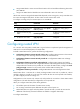
The route targets configured on the PEs must match those configured on the ASBR-PEs in the same AS to
make sure VPN routes sent by the PEs (or ASBR-PEs) can be received by the ASBR-PEs (or PEs). Route
targets configured on the PEs in different ASs do not have such requirements.
For more information, see "Configuring basic MPLS L3VPN."
Configuring inter-AS option B
Inter-AS option B solution requires that ASBR PEs maintain all VPNv4 routing information and advertise
the information to peer ASBR PEs. The ASBR PEs must receive all VPNv4 routing information without
performing route target-based filtering.
The route targets for the VPN instances on the PEs in different ASs must match for the same VPN.
An ASBR-PE always sets itself as the next hop of VPNv4 routes advertised to an MP-IBGP peer regardless
of the peer next-hop-local command.
ASBR-PEs use BGP to assign labels and create BGP LSPs. There is no need to configure MPLS LDP
between ASBR-PEs.