
R21xx-HP FlexFabric 11900 MPLS Configuration Guide


181
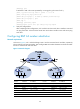
As shown in Figure 53, the IPv6 MPLS L3VPN packet forwarding procedure is using the following
process:
1. The PC at Site 1 sends an IPv6 packet destined for 2001:2::1, the PC at Site 2. CE 1 transmits the
packet to PE 1.
2. Based on the inbound interface and destination address of the packet, PE 1 finds a matching entry
from the routing table of the VPN instance, labels the packet with both inner and outer labels, and
forwards the packet out.
3. The MPLS backbone transmits the packet to PE 2 by outer label. The outer label is removed from
the packet at the penultimate hop.
4. According to the inner label and destination address of the packet, PE 2 searches the routing table
of the VPN instance to determine the outbound interface, and then forwards the packet out of the
interface to CE 2.
5. CE 2 forwards the packet to the destination by IPv6 forwarding.
IPv6 MPLS L3VPN routing information advertisement
The IPv6 VPN routing information of a local CE is advertised to the remote CE using the following
process:
1. From the local CE to the ingress PE:
The CE advertises standard IPv6 private routes to the PE through IPv6 static routing, RIPng, OSPFv3,
IPv6 IS-IS, or EBGP.
2. From the ingress PE to the egress PE:
After learning the IPv6 VPN routes from the CE, the ingress PE adds RDs and route targets for these
standard IPv6 routes to create VPN-IPv6 routes, saves them to the routing table of the VPN instance
created for the CE, and then triggers MPLS to assign VPN labels for them. Then, the ingress PE
advertises the VPN-IPv6 routes to the egress PE through MP-BGP.
The PEs use an IGP to ensure the connectivity between them.
3. From the egress PE to the remote peer CE:
The egress PE compares the export target attributes of the VPN-IPv6 routes with the import target
attributes that it maintains for the VPN instance and, if they are the same, adds the routes to the
routing table of the VPN instance. The egress PE restores the original IPv6 routes and advertises
them to the remote CE through IPv6 static routing, RIPng, OSPFv3, IPv6 IS-IS, or EBGP.
IPv6 MPLS L3VPN network schemes and functions
IPv6 MPLS L3VPN supports the following network schemes and functions:
• Basic VPN
• Inter-AS VPN option A
• Inter-AS VPN option C
IPv6 MPLS L3VPN configuration task list
By configuring basic IPv6 MPLS L3VPN, you can construct a simple IPv6 VPN network over an MPLS
backbone.